
Cold pressed juice is juice extracted from fruit and vegetables by pressing them, rather than separating the juice with a fast-spinning centrifugal blade. The term describes extraction, not the whole product: it does not automatically mean organic, unpasteurised, preservative-free or nutritionally equivalent to whole produce.
- Cold pressed juice describes extraction; check ingredients, processing and storage separately.
- Home Juice suits beginners seeking 100% certified organic cold-pressed juice with no additives or preservatives.
- Juice separates liquid from much of the pulp; smoothies retain more of the original produce.
- Choose your first bottle by ingredients and flavour, not by its colour or product name.
What is cold-pressed juice?
Cold-pressed juice comes from applying pressure to prepared produce to separate liquid from pulp. Equipment varies, but the distinction is the pressing stage. It is not simply fruit or vegetables blended into a drink.
For an Australian shopper in 2026, the useful question is what happens before and after extraction. Ingredients, any preservation treatment and storage instructions tell you more about the finished bottle than the words cold pressed alone.
Home Juice describes its cold-pressed juices as 100% certified organic, made with no heat and without additives or preservatives. Those are separate product details, not qualities you should assume every cold-pressed juice shares.
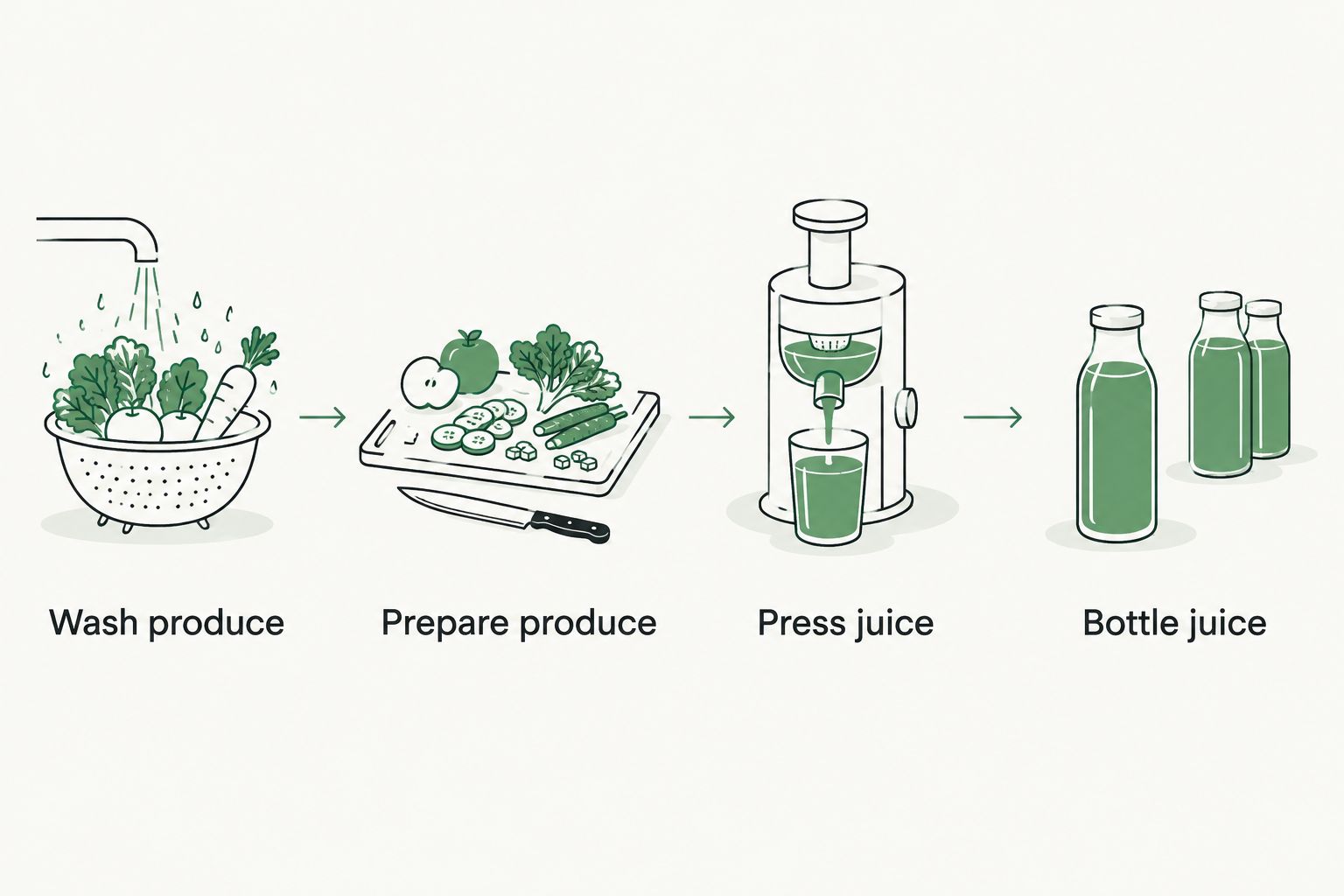
The basic process looks like this:
- Wash produce. Fruit and vegetables are cleaned before preparation.
- Prepare produce. Ingredients are trimmed and broken down as required by the equipment.
- Press juice. Pressure separates the liquid from much of the solid material.
- Bottle juice. The finished drink is packaged, with storage and handling requirements specific to that product.
The last step matters. A pressing method does not tell you whether the bottled juice has received a later treatment or how long it should stay in your fridge.
Why this matters when you choose a bottle
You do not need to learn juicing machinery to choose confidently. You need to separate three things: how the drink is extracted, what goes into it and how the finished product is handled.
A juice can be cold pressed without being certified organic. It can contain only fruit and vegetables yet still contain naturally occurring sugars. Neither detail contradicts the extraction method.
Use cold pressed as a description of the process, not a shortcut for judging everything in the bottle. That keeps your choice grounded in ingredients and your own preferences rather than an unfamiliar label.
How does cold-pressed juice compare with other options?
Cold pressing, centrifugal juicing and blending do different jobs. Whole produce offers another option altogether. None needs to replace all the others in your routine.
| Option | What happens | Best for | Practical advantage | Limitation |
|---|---|---|---|---|
| Cold-pressed juice | Pressure separates liquid from pulp | People who prefer an extracted juice | Lets you enjoy produce combinations in a drink | Much of the original fibre is left with the pulp |
| Centrifugal juice | A fast-spinning basket separates juice from prepared produce | People who prefer this style of home juicing | Produces extracted juice without a separate pressing stage | Also separates much of the pulp and fibre |
| Smoothie | A blender combines the ingredients | People who want a thicker drink retaining the blended produce | Keeps more of the original pulp in the drink | Texture depends on ingredients and added liquid |
| Whole fruit and vegetables | Produce is eaten rather than extracted | People who want the whole food | Retains the edible structure and fibre | Requires eating rather than drinking the produce |
Cold pressing does not turn juice into a smoothie. Even a cloudy juice with visible sediment has had solid material separated during extraction.
For your 2026 shopping shortlist, choose the format first. If you want a thicker drink, a smoothie fits that preference better than expecting a pressed juice to behave like one.
Is cold pressed the same as unpasteurised?
No. Cold pressed describes extraction; pasteurisation describes a separate treatment. Some bottled juices undergo heat treatment or high-pressure processing after extraction.
High-pressure processing is also different from the pressure used to extract juice. Do not assume that a reference to pressure on a label explains both stages.
If this distinction matters to your purchase, read the producer's processing information or ask directly. The words cold pressed alone do not confirm whether a juice is unpasteurised.
Is cold pressed the same as organic?
No. Organic describes how ingredients are produced and certified, not how juice is extracted. Check the organic information separately from the pressing claim.
A short ingredient list is useful, but it is not proof of organic certification. Likewise, an organic product still needs clear handling instructions and an ingredient list that suits you.
Why cold-pressed juice varies between bottles
Two cold-pressed juices can taste very different without either being made incorrectly. The ingredients and their balance shape the drink.
- Produce choice: Celery, carrot, citrus and leafy greens bring different flavours to a blend.
- Ingredient balance: A blend containing apple and orange is different from a single-ingredient celery juice.
- Seasonal produce: Natural variation in fruit and vegetables affects sweetness, colour and flavour.
- Pulp content: The amount of fine material remaining in the juice affects its texture and appearance.
- Processing and storage: Extraction does not explain every later treatment or handling requirement.
Colour is a useful visual clue, not a complete description. A green bottle can include fruit, while an orange blend can contain both fruit and vegetables.
Start with ingredients you already enjoy. You do not need to choose the strongest-tasting vegetable drink to make a sensible first purchase.
How do you choose your first cold-pressed juice?
A simple 2026 bottle check starts with the ingredient list and ends with your fridge. Work through these points before committing to a larger pack.
Start with flavour
Think about what you enjoy eating. If you like carrot, apple and orange, a blend built around those ingredients is an approachable starting point. If you enjoy celery's distinct flavour, a single-ingredient option gives you exactly that.
Do not choose by colour alone. Read the ingredients before deciding whether a juice sounds sweet, sharp, earthy or vegetable-led.
Check the full ingredient list
Look beyond the front label. The list tells you whether you are choosing straight juice or a drink containing other ingredients, such as water, herbs, spices or sweeteners.
Different drink types can all have a place in your routine. The point is to know which one you are buying rather than assuming every bottle contains the same kind of product.
Read the nutrition panel in context
Compare like with like using the per-100 ml column, then check the amount in the bottle. A serving listed on a nutrition panel is not always the whole container.
No added sugar does not mean sugar-free. Fruit and vegetables contain naturally occurring sugars, and cold pressing does not remove them. Use the actual label rather than guessing from a green colour or a vegetable-led name.
Check storage before ordering
Read the product's refrigeration, use-by and after-opening instructions. Make room before your bottles arrive, and arrange transport so a refrigerated product stays cold.
Do not apply a shelf-life number from another brand or a different juice. Ingredients, processing and packaging differ, so the instructions for your actual bottle take priority.
Choose an amount that fits your routine
Begin with what you can store and use as directed. A larger order is not automatically a better fit if it crowds your fridge or gives you more flavours than you want.
Home Juice uses 375 ml servings and describes its cleanse format as seven juices per day. Seven 375 ml servings total 2,625 ml: that describes the product format, not a recommendation for how much juice everyone should drink.
Two straightforward flavours to consider
Home Juice is a practical choice for beginners seeking certified-organic cold-pressed juice with clear ingredient lists. The advantage is being able to choose by familiar produce; the limitation is that juice still differs from eating the whole ingredients.
These options offer contrasting starting points without requiring you to choose a cleanse program.
| Product | Listed ingredients | Best for | What works | What to consider |
|---|---|---|---|---|
| Summer Sunset | Carrot, apple, orange, turmeric | Beginners who prefer a sweeter blend | Familiar fruit and vegetable ingredients | Its sweeter flavour will not suit someone seeking a straight vegetable juice |
| Celery Juice | 100% celery juice | People who already enjoy celery | A single ingredient makes the flavour choice clear | Celery's distinctive taste will not suit every beginner |
Best for a fruit-and-vegetable introduction: Summer Sunset. Its description identifies it as the sweetest juice in the range, so choose it for that flavour preference rather than expecting a savoury green drink.
Best for a single-ingredient choice: Celery Juice. Choose it because you like celery and want a straightforward ingredient list, not because you expect a particular health outcome.


Does cold-pressed juice replace whole fruit and vegetables?
No. Cold-pressed juice separates liquid from much of the pulp, so it is not equivalent to eating the whole ingredients. Whole produce retains its edible structure and fibre.
That does not make choosing a juice complicated. Treat it as a drink you enjoy alongside a varied eating routine, rather than a replacement for every form of fruit and vegetables.
A juice product name is also not a reason to skip meals. If you are considering a restrictive eating program, get individual advice from an accredited practising dietitian rather than treating the bottle's description as a meal plan.
How should you store cold-pressed juice?
Follow the instructions on the bottle, including refrigeration and any directions for use after opening. Cold pressed does not provide a universal storage period.
For your 2026 fridge routine, keep labels visible and put bottles with the earliest use-by dates at the front. That makes the next choice simple without relying on memory.
Natural settling can occur in juice, but appearance alone cannot establish safety. Follow any shaking instructions and do not use smell or taste as a substitute for the label's handling directions.
FAQ
What does cold pressed juice actually mean?
Cold pressed juice means juice extracted from fruit and vegetables using pressure. The term describes extraction, not organic certification, pasteurisation or the finished drink's full ingredient list.
Is cold-pressed juice better than a smoothie?
Cold-pressed juice and smoothies suit different preferences: juice separates liquid from much of the pulp, while smoothies retain more of the blended produce. Choose juice for an extracted drink and a smoothie for a thicker texture.
Does cold-pressed juice have sugar in it?
Cold-pressed juice contains naturally occurring sugars from its ingredients. Check the nutrition panel and ingredient list; no added sugar does not mean sugar-free.
Is every cold-pressed juice organic?
Not every cold-pressed juice is organic. Organic certification and cold pressing describe different parts of production, so check each claim separately.
How big are Home Juice servings?
Home Juice servings are 375 ml, and its cleanse format contains seven juices per day. That describes the product format rather than a recommended juice intake for everyone.
Can I tell how long cold-pressed juice lasts from the name?
You cannot determine shelf life from the words cold pressed. Follow the specific bottle's use-by date, refrigeration requirements and after-opening instructions.
Do I need to start with a juice cleanse?
You do not need to start with a juice cleanse to try cold-pressed juice. Choose a flavour you enjoy first and keep the rest of your eating routine varied.
One last thing
The most useful detail on a juice bottle is often on the back. Two drinks can both say cold pressed while having different ingredients, serving sizes and storage requirements.
Make this your 2026 buying rule: read the ingredients, check the bottle size and follow the storage label before choosing by the front-of-pack wording. You can start with one flavour preference; you do not need a whole new routine.