
Cold-pressed juice differs from normal juice mainly in extraction: it uses pressure to squeeze liquid from produce, while a centrifugal juicer uses a fast-spinning blade and basket. Neither method alone tells you whether the finished juice is heat-treated, what ingredients it contains or how it compares nutritionally, so check the whole label rather than treating ‘cold-pressed’ as a guarantee.
- Cold pressed juice vs normal juice is primarily an extraction comparison, not proof of better nutrition.
- Cold-pressed juice can still undergo preservation after extraction; check processing and storage instructions separately.
- Compare juice ingredients and nutrition per 100 ml rather than judging by colour or bottle size.
- Homejuice suits shoppers seeking certified-organic cold-pressed juice with no heat, additives or preservatives.
How does cold-pressed juice differ from normal juice?
Cold-pressed juice uses pressure to separate juice from fruit and vegetables. ‘Normal juice’ is not one defined production method: it can mean juice from a centrifugal machine, freshly squeezed juice, juice made from concentrate or a heat-pasteurised supermarket bottle.
When comparing bottles in 2026, separate extraction, preservation and ingredients. They describe different parts of production, including when you browse the cold-pressed juice range at Homejuice.
| Method or treatment | What happens | Best for | Advantage | Limitation |
|---|---|---|---|---|
| Cold pressing | Pressure extracts liquid from prepared produce | Shoppers who specifically want pressed juice | Offers a clearly identifiable extraction method | Does not establish sugar content, fibre content or preservation method |
| Centrifugal juicing | A spinning blade breaks up produce and a basket separates juice from pulp | People who value quick home preparation | Makes juice quickly without a separate pressing stage | Separates out pulp; results depend on produce and equipment |
| Heat pasteurisation | Heat treats juice after extraction | Shoppers choosing a heat-treated juice | Helps control harmful microorganisms | Is a preservation treatment, not an extraction method; flavour can change |
These categories overlap. A producer can cold-press juice and then apply a preservation treatment, so a bottle can belong to more than one row.
The useful comparison is the finished drink, not just the machine that made it. That means reading the ingredients, nutrition information and handling instructions together.
Why this matters
A juice bottle has several jobs to explain: what is inside, how it was made and how you should keep it. A single phrase on the front cannot answer all three.
For your 2026 shop, start with the decision you actually need to make. If you want a particular flavour, ingredients come first; if you want juice made without heat, the processing information matters more than the colour of the drink.
You do not need to learn every manufacturing term. You just need to avoid mistaking one useful detail, such as cold pressing, for a complete description of the product.
What actually happens during cold pressing?
Cold pressing uses mechanical pressure to extract juice from prepared fruit and vegetables. Depending on the equipment, produce is crushed or ground before pressing, with much of the solid material left behind as pulp.
The term describes extraction without deliberate heat treatment at that stage. It does not mean that every bottle carrying the term has followed the same journey afterwards.
That distinction matters when you see ‘cold-pressed’, ‘raw’, ‘unpasteurised’ or ‘from concentrate’. These phrases are not interchangeable, and one does not automatically establish the others.
What happens in a centrifugal juicer?
A centrifugal juicer breaks up produce with a spinning blade and separates liquid from pulp through a basket. It is a different way to extract juice, not proof that the resulting drink contains additives or has been heat-pasteurised.
Freshly made centrifugal juice can have a very short ingredient list: just the produce you put in. Conversely, a bottled cold-pressed blend can contain several ingredients, so judge the recipe separately from the extraction method.
Where does supermarket juice fit?
‘Supermarket juice’ describes where you buy it, not how it is made. Read the individual bottle rather than assuming everything on the same shelf shares a process.
Likewise, ‘from concentrate’ describes another production step: water is removed from juice and later added back. It does not, by itself, tell you whether sugar has been added; the ingredients list answers that question.
Is cold-pressed juice automatically more nutritious?
Cold-pressed juice is not automatically more nutritious than every other juice. Its nutrient content depends on the produce, recipe, processing and storage, not extraction alone.
Heat can affect some heat-sensitive nutrients, but that fact does not support a blanket claim that all cold-pressed juice contains more vitamins. Different recipes can make the comparison unequal before processing even enters the picture.
A vegetable-heavy blend and a fruit-only juice are different drinks. Comparing them solely on the words ‘cold-pressed’ and ‘normal’ leaves out the ingredients doing much of the work.
Does cold pressing keep all the fibre?
Cold pressing does not keep all the fibre in whole fruit and vegetables. Juicing separates liquid from solid material, leaving much of the fibre in the pulp.
Some juice contains suspended pulp, but that does not make it equivalent to eating the original produce. Enjoy juice as a drink rather than treating it as a replacement for whole fruit and vegetables.
Does cold-pressed mean less sugar?
Cold-pressed does not mean low sugar. Fruit and vegetables contain naturally occurring sugars, and the amount in the finished drink depends on its ingredients and concentration.
Compare the nutrition information per 100 ml to put different bottles on the same basis. Then check the amount you actually drink, because a larger serving changes your total intake even when the recipe is identical.
‘No added sugar’ and ‘sugar-free’ also mean different things. A juice can contain no added sugar while still containing sugars naturally present in its ingredients.
Why the taste and drinking experience vary
Two juices made with the same extraction method can taste quite different. Before deciding that you prefer one method, check these five factors:
- Produce mix: Celery, citrus, carrot and apple bring different flavours. A change in recipe can matter more to your enjoyment than the extraction label.
- Ingredient proportions: Listing the same fruits and vegetables does not mean two bottles contain them in the same proportions.
- Pulp content: The amount of suspended pulp affects texture. A clearer drink and a pulpy drink can feel quite different without either being a better fit for everyone.
- Preservation treatment: Heating and other treatments are separate from extraction. Check what the producer states rather than guessing from the bottle’s appearance.
- Storage and handling: Follow the product’s instructions from purchase to pouring. Extraction method alone does not tell you how to handle the finished drink.
Choose flavours you already enjoy if you are new to vegetable juice. You do not need to start with the strongest-tasting blend to make a confident choice.
Your 2026 label checklist
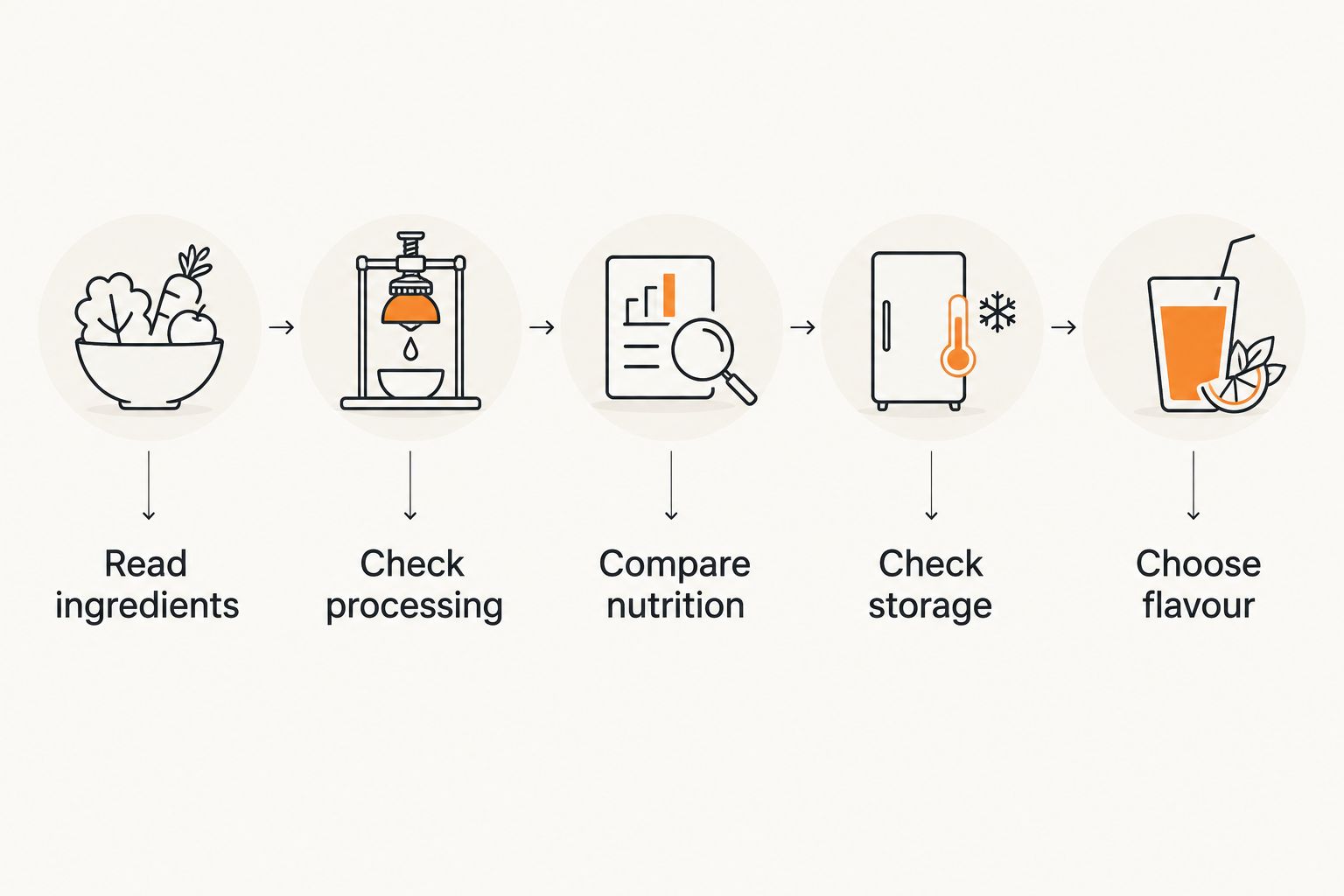
Use the same sequence for every bottle. It keeps the comparison fair and helps you separate a preference for pressed juice from questions about ingredients or serving size.
- Read ingredients. Identify the fruits, vegetables and any other ingredients. Decide whether that combination sounds appealing before focusing on front-label wording.
- Check processing. Look for clear information about extraction and any treatment afterwards. Do not assume cold pressing answers both questions.
- Compare nutrition. Use the per-100 ml column when comparing different bottle sizes. Read the serving column separately to understand the amount you plan to drink.
- Check storage. Read the storage directions, date marking and instructions after opening. Make sure you can follow them at home and while travelling.
- Choose flavour. Pick a recipe you will enjoy drinking. A suitable label is useful, but an unwanted flavour is still an unwanted drink.
A useful final check is to turn the bottle around before deciding. The front introduces the drink; the back usually carries the details needed to compare it properly.
What does Homejuice offer cold-pressed juice shoppers?
Homejuice cold-pressed juice is 100% certified organic, made with no heat, and contains no additives or preservatives. The range uses recyclable packaging and includes 375 ml servings.
Homejuice is best for shoppers who want certified-organic cold-pressed juice made without heat, additives or preservatives. Those are specific product attributes you can choose for, without attaching a promised health outcome to the bottle.
For a simple ingredient example, Celery Juice contains 100% celery juice. It suits someone who wants a single-ingredient drink, but not someone looking for a fruit blend.
The limitation is the same one that applies across the category: cold-pressed juice does not replace the fibre and eating experience of whole produce. Organic certification and no-heat processing also do not establish that a drink is low in sugar; check the individual nutrition information.
For a 2026 shopping decision, choose these attributes because they match your preferences. You do not need an elaborate routine to enjoy a juice you like.
How should you store cold-pressed juice?
Store cold-pressed juice exactly as its label directs. Do not use a general shelf-life claim as a substitute for the bottle’s date marking or instructions after opening.
‘Cold-pressed’ does not give you a universal fridge life because extraction is only part of production. Packaging, preservation and handling also matter, so two cold-pressed products need not carry identical directions.
If your 2026 routine includes taking juice to work, plan how you will follow any refrigeration instructions during the journey and at your destination. A desk or car is not a substitute for refrigerated storage when the label requires it.
Read before you pour. Appearance and smell alone cannot establish that a drink is safe, and an unopened bottle’s date does not override separate directions for use after opening.
Which juice should you choose as a beginner?
Choose the juice whose ingredients, processing and handling requirements match what you want. There is no need to treat the choice as a test of how committed you are to a particular routine.
If you specifically want juice extracted by pressure, look for cold-pressed. If you already enjoy another juice, compare its label before assuming you need to replace it.
Keep the first decision simple: identify a flavour you enjoy, check the nutrition information and confirm you can store it correctly. You can explore other recipes once you know what suits your taste.
Choose on evidence you can read, not benefits you are asked to imagine. That approach works whether you are buying a single bottle or planning drinks for the week.
FAQ
Is cold-pressed juice better than normal juice?
Cold-pressed juice is better suited to shoppers who specifically want pressure-extracted juice, but it is not automatically more nutritious. Compare ingredients, nutrition information, preservation and storage requirements before choosing.
Does cold-pressed juice have less sugar?
Cold-pressed juice does not automatically have less sugar than other juice. Compare the nutrition information per 100 ml, then check the serving size you plan to drink.
Is cold-pressed juice the same as unpasteurised juice?
Cold-pressed juice is not necessarily unpasteurised. Cold pressing describes extraction, while pasteurisation describes a treatment applied to the juice; check the producer’s processing information.
Does cold-pressed juice contain all the fibre from fruit and vegetables?
Cold-pressed juice does not contain all the fibre from the original fruit and vegetables. Juicing leaves much of the fibre in the separated pulp, so keep whole produce in your meals too.
Can normal juice be made without added sugar?
Normal juice can be made without added sugar. Check the ingredients list rather than assuming that only cold-pressed juice can have a simple recipe.
How long can I keep cold-pressed juice in the fridge?
Keep cold-pressed juice only as directed by its label, including its date marking and instructions after opening. There is no universal fridge life established by the term cold-pressed.
What should I check first when buying juice?
Check the ingredients first, then processing, nutrition information and storage instructions. Comparing nutrition per 100 ml helps you assess bottles of different sizes fairly.
One last thing
The most useful comparison can be between two bottles labelled ‘cold-pressed’. Different recipes, serving sizes and preservation methods still make them different products.
In 2026, make one habit your starting point: read the back label before choosing from the front label. It is a small step that answers more than the extraction claim alone.