
Cold-pressed juice lasts in the fridge for the period stated on its label, provided you follow its storage instructions; there is no single shelf life that applies to every bottle. Once opened, follow the separate opening instructions and never extend the use-by date. For your 2026 shopping and storage routine, check the date, refrigeration requirements and opening guidance before planning when to drink it.
- How long does cold pressed juice last? Follow the bottle’s use-by date and instructions after opening.
- Homejuice cold-pressed juice suits shoppers seeking certified-organic drinks; organic certification does not establish shelf life.
- Keep refrigerated juice cold during transport and storage, not just after opening.
- An unopened seal, normal colour or fresh smell cannot establish that juice is safe.
How long does cold-pressed juice last in the fridge?
The bottle’s instructions—not a general day count—determine how long you should keep packaged cold-pressed juice. A date on an unopened bottle and an instruction about drinking it after opening answer different questions. You need to follow both.
When choosing Homejuice cold-pressed juice, make checking the storage instructions part of your order planning. Buying enough for your routine only helps if you can store and drink it within the stated period.
| Bottle situation | What determines how long it lasts | Useful feature | Limitation to remember |
|---|---|---|---|
| Unopened, commercially packaged juice | Labelled date and storage instructions | The original label gives product-specific guidance | The date depends on correct storage |
| Opened, commercially packaged juice | After-opening instructions and the original use-by date | You can track when you opened it | Opening does not restart or extend the use-by period |
| Homemade cold-pressed juice | Preparation hygiene, ingredients and storage guidance | You know when you prepared it | A commercial bottle’s shelf life does not apply |
| Juice with an uncertain storage history | Whether its storage requirements were maintained | Checking its history helps you avoid guessing | Putting it back in the fridge does not undo earlier mishandling |
There is no reliable shortcut from “cold-pressed” to a fixed number of fridge days. The term describes extraction, not a complete preservation method or a safety guarantee.
Why this matters
A bottle can look perfectly ordinary even when its storage history is uncertain. That makes dates and handling instructions more useful than deciding by appearance alone.
For your 2026 routine, separate quality from safety. A change in flavour or colour concerns quality; a use-by date concerns safety. Neither a pleasant smell nor an appealing colour overrides a use-by date.
A little planning also reduces avoidable waste. Keep labels visible, open bottles deliberately and put the earliest use-by dates at the front, rather than choosing only by flavour.
Unopened juice: follow the date and storage instructions
An unopened bottle is not automatically suitable for a long stay in the fridge. Its labelled shelf life assumes you have stored it as directed, including during the trip home.
Check whether the label carries a use-by or best-before date. Food Standards Australia New Zealand distinguishes these clearly: a use-by date concerns safety, while a best-before date concerns quality. Do not drink juice after its use-by date.
Before you put an unopened bottle away:
- Read the refrigeration instructions, including any specified temperature.
- Check the date on that particular bottle, rather than another bottle from the same order.
- Make sure the cap and seal are intact.
- Keep the label attached so you retain the storage guidance.
- Arrange bottles so the earliest use-by date is easiest to reach.
If the date is unreadable or the instructions are unclear, ask the supplier before drinking it. Do not substitute a shelf-life estimate from another juice, even if the ingredients sound similar.
Opened juice: follow the shorter applicable limit
Opening changes the situation. The juice is exposed to handling and the surrounding environment, so an unopened shelf-life statement is no longer enough on its own.
Follow the after-opening instruction without going beyond the original use-by date. If the bottle has no clear opening guidance, ask the supplier rather than assuming it lasts as long as an unopened bottle.
Mark the opening date on the bottle or in your phone. Close the cap promptly and return the bottle to the fridge after pouring; leaving it beside your breakfast or work bag adds unnecessary time out of refrigeration.
Pouring into a clean glass also avoids drinking directly from a bottle you intend to keep. It is a simple handling habit, not a way to extend the labelled storage period.
Homemade juice: do not borrow a bottled juice’s shelf life
Homemade juice has no manufacturer-validated use-by date. Your ingredients, equipment, preparation and storage conditions differ from those used for a commercially packaged product.
Prepare only what you have a clear plan to drink, using clean equipment and suitable containers. Refrigerate promptly and follow reliable food-safety guidance for your preparation method.
Do not treat a clean bottle, a tightly closed lid or added lemon juice as proof of a longer safe storage period. None gives you a validated replacement for product-specific shelf-life advice.
Why cold-pressed juice shelf life varies
The following factors explain why a general answer cannot replace the instructions on your bottle:
- Processing: Cold pressing describes juice extraction. It does not tell you every preservation or packaging step used afterwards.
- Ingredients: Different recipes have different characteristics. Colour or sweetness alone cannot establish safe storage time.
- Packaging: An intact original seal and an opened bottle are different storage situations.
- Temperature: Shelf-life guidance depends on maintaining the required storage conditions, including during transport.
- Handling: Clean pouring, prompt recapping and returning the bottle to refrigeration reduce unnecessary exposure.
- Time after opening: Any after-opening instruction applies alongside the original date, not instead of it.
“Organic” and “preservative-free” describe product attributes, not an expiry calculation. You cannot add or subtract fridge days based on those words alone.
How should you store cold-pressed juice at home?
For Australian food storage in 2026, Food Standards Australia New Zealand advises keeping potentially hazardous food at 5°C or colder. Follow your juice’s own instructions if they specify a stricter temperature; this general benchmark does not establish a juice’s shelf life.
Use a fridge thermometer to check the actual temperature rather than relying only on the control setting. A dial position tells you what you selected, not necessarily the temperature around your bottles.
Make the routine straightforward:
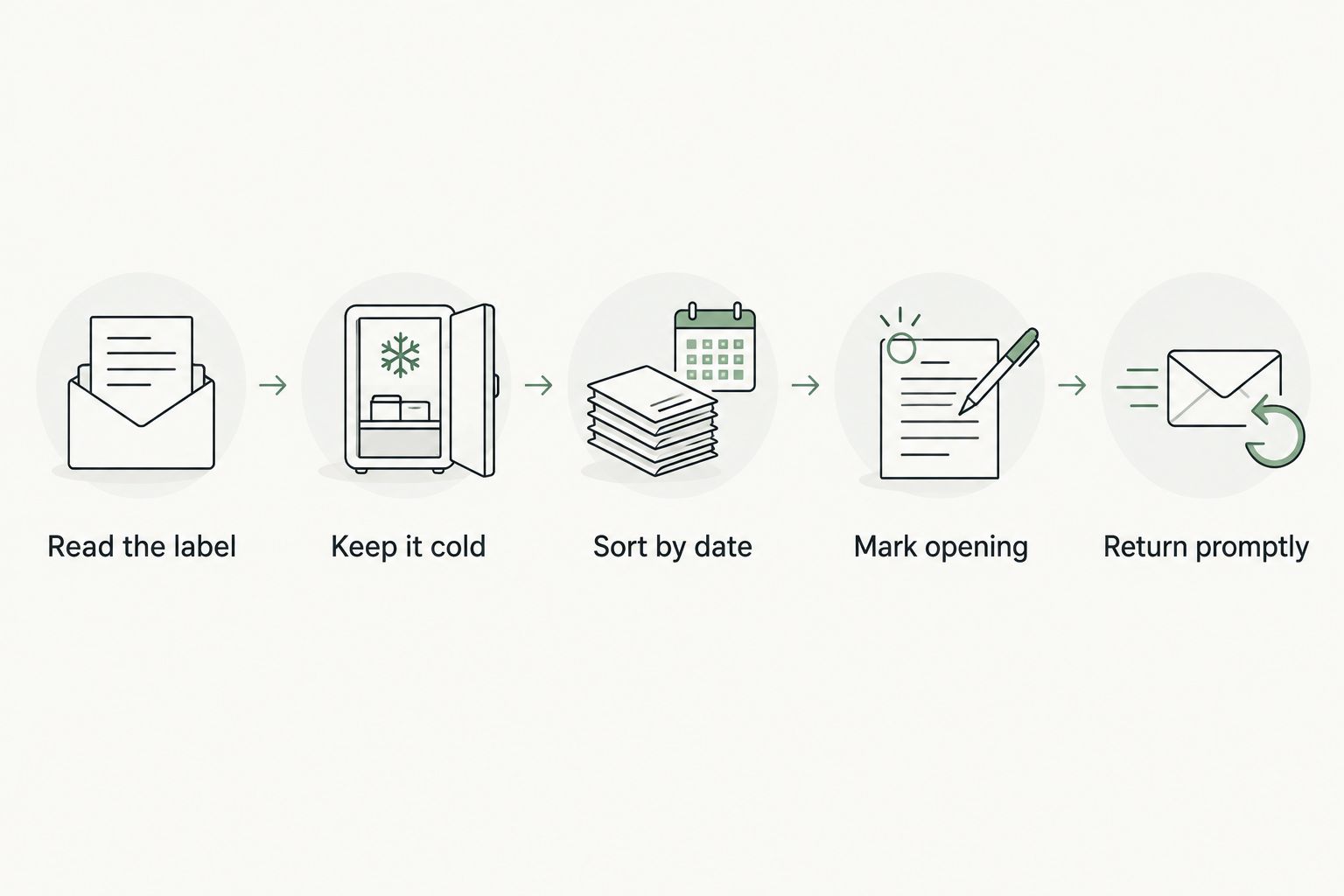
- Read the label: Identify the date, refrigeration requirements and opening instructions before putting the bottle away.
- Keep it cold: Take refrigerated juice home promptly and use an insulated bag with a cold source when needed.
- Sort by date: Put the earliest use-by dates where you can see and reach them.
- Mark opening: Record when you first open a bottle and follow the applicable instructions.
- Return promptly: Put the capped bottle back in the fridge after pouring.
Leave enough room for cold air to circulate around stored food. If your fridge is crowded, organise the space before bringing home a large juice order rather than leaving bottles on the bench while you make room.
What if your juice has been out of the fridge?
Check the bottle’s instructions and consider the whole period out of refrigeration—not just the most recent trip from the fridge. Transport, time on a desk and time on the kitchen bench all form part of its handling history.
Food Standards Australia New Zealand’s 2-hour/4-hour rule applies to potentially hazardous food held between 5°C and 60°C. Under that rule, less than 2 hours allows use or re-refrigeration; between 2 and 4 hours means use immediately; more than 4 hours means discard.
That rule is not a universal shelf-life allowance for every cold-pressed juice. Whether a particular juice falls within that food category depends on its characteristics. Do not use the rule to override stricter product instructions or justify drinking a bottle with an uncertain history.
If a refrigerated delivery arrives warm, contact the supplier before drinking it. Cooling it afterwards does not establish that it was handled correctly beforehand.
How can you tell if cold-pressed juice has gone off?
An unusual smell, mould, leakage, unexpected gas or a swollen container are reasons not to drink the juice. Do not taste it to investigate.
However, the absence of those signs does not prove safety. Food-safety hazards do not always produce a warning you can see, smell or taste, so date and temperature checks still come first.
Some juices separate during storage. Separation alone cannot tell you whether a bottle is safe or spoiled; follow any shaking instructions only after checking its date, storage history and packaging condition.
For your 2026 fridge checklist, use this order: instructions first, storage history second, visible warning signs third. A fresh smell never cancels a failed check earlier in that sequence.
Can you freeze cold-pressed juice to make it last longer?
Freezing is not a way to rescue juice that is past its use-by date or has been mishandled. It also does not give you a new, validated shelf life for an unfamiliar product.
Ask the supplier whether freezing is suitable for that juice and its container, then follow its freezing and thawing instructions. Do not assume a bottle has enough expansion space or is suitable for the freezer.
If freezing is permitted, label what you froze and when. Keep the original storage information so you can follow the correct instructions after thawing rather than guessing from memory.
Plan your order around your fridge
Homejuice cold-pressed juice is best for shoppers seeking 100% certified-organic drinks. Its juices are cold-pressed with no heat and contain no additives or preservatives; those features describe the product, not how many days you can store it.
Homejuice offers 375 ml servings and seven juices per cleanse day. If you choose that format, allow space for the bottles and check their dates before planning your schedule. The practical trade-off is that a multi-bottle order needs more fridge organisation than an occasional drink.
Choose your order around the labelled storage period, your available space and when you will actually drink it. A programme’s duration is not, by itself, a statement about how long every bottle lasts.
FAQ
How long does cold pressed juice last in the fridge in 2026?
Cold-pressed juice lasts for the period stated on its label when stored as instructed. After opening, follow the separate opening guidance without extending the original use-by date.
Does unopened cold-pressed juice last longer than opened juice?
An unopened bottle and an opened bottle have different storage requirements. Follow the unopened date before opening, then apply the after-opening instructions alongside that original date.
Can I drink cold-pressed juice after its use-by date?
Do not drink cold-pressed juice after its use-by date. A normal smell, colour or taste does not override a safety-based date.
What temperature should I keep my juice at?
Keep your juice at the temperature stated on its label. Australian guidance specifies 5°C or colder for potentially hazardous food, but that benchmark does not establish an individual juice’s shelf life.
Is cold-pressed juice safe if it smells fine?
A normal smell does not prove cold-pressed juice is safe. Check the date, storage instructions, opening guidance and temperature history before drinking it.
Does organic cold-pressed juice last longer?
Organic certification does not establish a longer shelf life. Follow the particular bottle’s date and storage instructions rather than inferring storage time from its organic status.
Can I freeze a bottle before its use-by date?
Ask the supplier whether freezing is suitable for the juice and its container. Follow product-specific freezing and thawing instructions, and never freeze a mishandled bottle as a way to make it safe.
One last thing
The date you open a bottle deserves a place beside the date printed on it. Put a washable marker near your fridge or make a quick phone note when you open your juice.
That small habit removes a common uncertainty: remembering whether you opened the bottle recently or several mornings ago. Keep the original label readable, and let the instructions—not your memory—guide the decision.