
Yes, you can freeze cold-pressed juice, provided the product’s storage instructions allow it and you freeze it while it is still fresh and properly chilled. Use a freezer-safe container with room for the liquid to expand, then thaw it in the fridge. Freezing can change the texture and flavour, and it does not make spoiled or improperly stored juice safe to drink.
- Can you freeze cold pressed juice? Yes, if product instructions allow it; use freezer-safe containers and thaw refrigerated.
- Homejuice cold-pressed juice needs product-specific storage instructions, not a generic freezer shelf-life promise.
- Freezing and thawing can change flavour and texture; separation alone does not establish whether juice is safe.
- Freeze manageable portions while fresh, label them clearly and avoid repeated thawing and refreezing.
Can you freeze cold-pressed juice?
Cold-pressed juice can be frozen, but the juice’s condition and container matter as much as the freezing itself. For Homejuice cold-pressed juice, check the individual product’s storage directions before deciding which bottles belong in your freezer. Do not assume every drink in a mixed order has the same instructions.
Use this practical sequence:
- Read the label. Check refrigeration requirements, the use-by date and any freezing or after-opening directions. Follow a specific instruction not to freeze.
- Check the storage history. Only freeze juice that has stayed appropriately chilled. Freezing is not a way to rescue a bottle left warm for too long.
- Choose the container. Use packaging explicitly suitable for freezing liquids. An unopened retail bottle is not automatically freezer-safe.
- Leave expansion space. Follow the container manufacturer’s filling limit rather than filling to the rim. Juice expands as it freezes.
- Label before freezing. Record the flavour, freezing date and any relevant after-opening instructions. Keep the original label or a clear photo of it.
- Thaw in the fridge. Keep the container covered, upright and on a tray to catch leaks. Follow the maker’s instructions for use after thawing.
You do not need an elaborate system. You need a suitable container, a reliable cold chain and enough information to identify what you froze.
Why this matters
Freezing is useful when your plans change and you cannot drink every bottle within its refrigerated use window. It lets you separate what you intend to drink soon from what you want to save, without leaving the decision until a bottle is already past its use-by date.
For your 2026 storage routine, keep two questions separate: is the juice still safe to store, and will you enjoy its texture after thawing? A bottle can develop harmless-looking separation, but appearance alone cannot confirm safety. Equally, a smooth-looking juice is not proof that it has been stored correctly.
For bottles staying chilled, see how long cold-pressed juice lasts in the fridge. Refrigerated storage and frozen storage need different decisions.
Is refrigerating or freezing cold-pressed juice better?
Refrigeration is best for juice you will drink within its labelled refrigerated window; freezing is best for saving suitable juice for later. Neither option overrides the product’s instructions. Choose according to when you will actually use the bottle, not when you hope to use it.
| Storage option | Best for | Main advantage | Main limitation |
|---|---|---|---|
| Refrigeration | Juice you will drink within its labelled refrigerated window | Avoids the texture changes caused by freezing and thawing | The labelled use-by and after-opening limits still apply |
| Freezing | Suitable juice you want to save before its refrigerated window ends | Allows you to store portions for later use | Requires suitable packaging, thawing and acceptance of possible texture changes |
Food Standards Australia New Zealand advises keeping potentially hazardous food at 5°C or colder. For frozen storage, −18°C or colder is the standard household freezer target reflected in established food-storage guidance, including guidance from the US Department of Agriculture.
These temperatures describe storage conditions, not a guaranteed shelf life for a particular juice. Use appliance thermometers to check conditions rather than relying only on a dial setting.
Why freezing results vary
Two juices can look different after thawing without either result being surprising. Ingredients, pulp and packaging all affect what you see and taste.
- Ingredient mix: Different fruit and vegetable blends have different flavours, solids and textures. Do not expect every blend to thaw identically.
- Pulp content: Suspended pulp can settle or clump after freezing. A smoother juice and a pulpier juice will not necessarily have the same mouthfeel afterwards.
- Freshness before freezing: Freezing does not reverse deterioration that has already happened. Start with juice that remains within its storage instructions.
- Container choice: Packaging must tolerate both low temperatures and expanding liquid. A food-safe container is not necessarily suitable for freezing.
- Storage and handling: A consistently frozen bottle has a different handling history from one repeatedly taken out, partly thawed and returned to the freezer.
Choose your freezing method around the actual bottle, not a general claim that all cold-pressed juice freezes perfectly. If you are unsure about packaging or instructions, ask the maker before freezing the rest of an order.
Does freezing cold-pressed juice change the taste or texture?
Freezing can change cold-pressed juice’s taste and texture, especially its consistency after thawing. Ice formation and thawing can alter how pulp and liquid sit together. You might notice a clearer liquid layer above settled solids, or a less uniform texture than before freezing.
Once the juice has thawed in the fridge, gently mix it if the product instructions allow. Mixing can redistribute settled ingredients, but it cannot reverse spoilage or guarantee that the original texture will return.
Separation is a texture observation, not a safety test. Assess the bottle using its storage history, packaging condition and label instructions, not just whether shaking makes it look familiar again.
If texture matters to you, freeze a small portion before committing a whole order. That gives you a practical answer about your preference without assuming every flavour will behave the same way. You can then decide whether that juice suits drinking after thawing or whether you prefer keeping future bottles refrigerated.
Can you freeze cold-pressed juice in its original bottle?
You can freeze cold-pressed juice in its original bottle only when that bottle and its closure are suitable for freezing and there is enough expansion space. Check the packaging instructions or ask the maker. The fact that a bottle holds chilled juice does not establish that it can safely hold frozen juice.
Be especially careful with glass. Use only glass containers explicitly designed for freezing, and follow their filling and handling directions. Ordinary glass bottles can crack as liquid expands or when exposed to sudden temperature changes.
If the original bottle is unsuitable, transfer the juice into a clean, food-safe, freezer-safe container. Keep the flavour and storage information with the new container so you do not lose the instructions during the transfer.
For your 2026 freezer labels, include the freezing date and whether the juice was opened before freezing. A short, readable label is more useful than a collection of identical containers you cannot confidently identify.
How long can you keep cold-pressed juice in the freezer?
There is no single freezer duration that applies to every cold-pressed juice. Use the maker’s frozen-storage guidance where it is provided. A general recommendation for another juice, another processing method or another package is not a substitute for instructions covering your bottle.
Freezer temperature, packaging and the juice’s condition before freezing all matter. A use-by date printed for refrigerated storage also does not automatically explain how long the product can be kept after freezing or thawing.
If you are planning a 2026 order around freezer storage, confirm the freezing and thawed-use instructions before buying more than you can otherwise use. Ask a precise question: can this particular juice be frozen, in this packaging, and what instructions apply after thawing?
Do not create a new use-by date yourself. Keep the original information and follow the maker’s advice rather than adding an assumed number of weeks or months.
How do you thaw cold-pressed juice safely?
Thaw cold-pressed juice in the fridge, not on the kitchen bench. The outside of a container warms before its frozen centre has completely thawed, so a bottle can still contain ice while its outer layers are getting warmer.
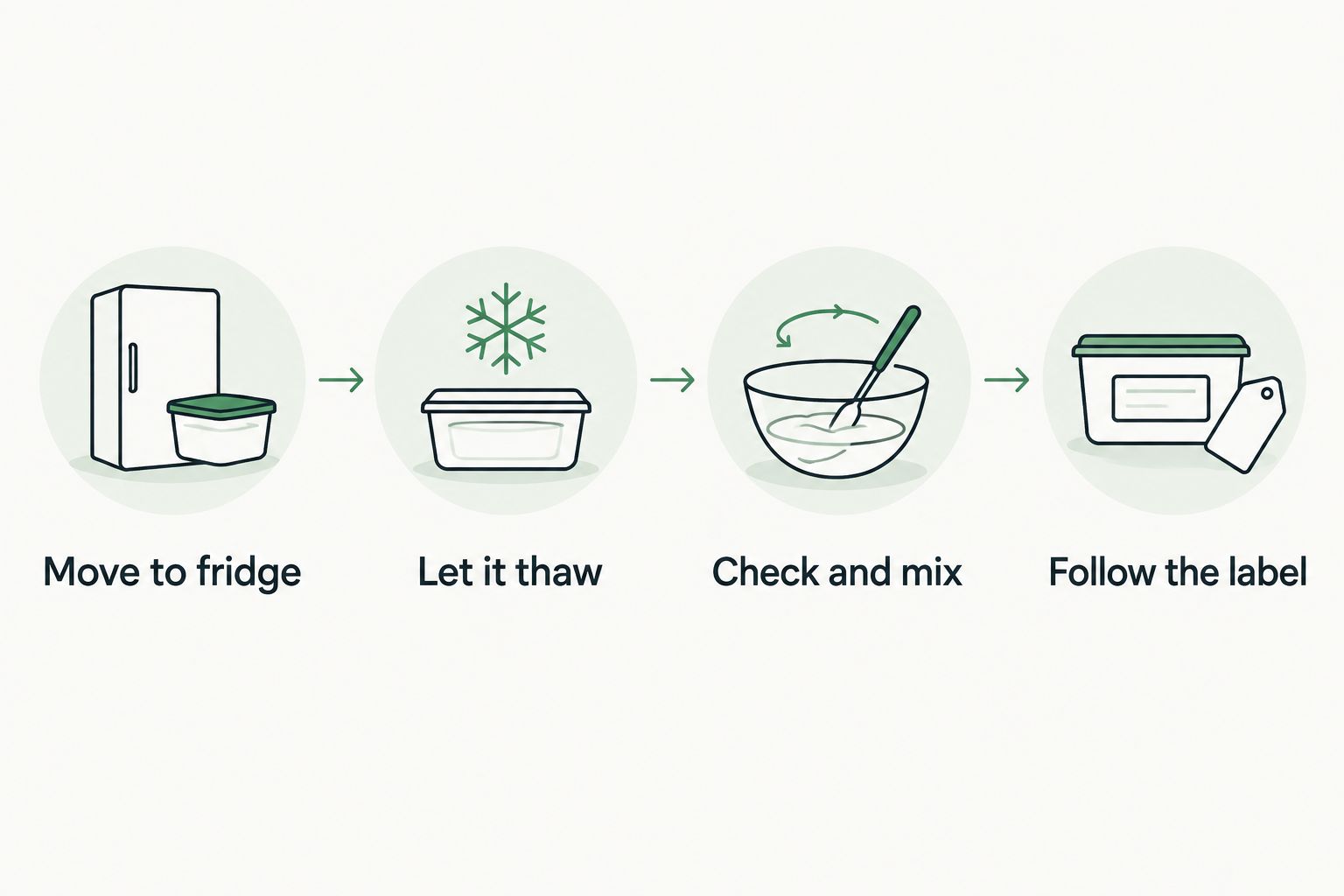
Use this order when you are ready to drink it:
- Move to fridge. Put the frozen container upright on a tray. Leave its lid or closure in place as directed by the container instructions.
- Let it thaw. Allow the juice to thaw under refrigeration. Container size and freezer conditions affect the time needed, so do not rely on a universal timetable.
- Check and mix. Check the container for damage and follow any mixing directions. Do not drink from cracked glass or a damaged container.
- Follow the label. Use the maker’s thawed-use and after-opening instructions. Thawing does not give the juice a new, unrestricted refrigerated life.
Avoid using a microwave or hot water as a shortcut for juice you intend to drink cold. Plan ahead instead, and leave any remaining juice refrigerated according to its instructions.
If a bottle has spent too long warm, do not freeze it again as a fix. Food Standards Australia New Zealand’s guidance for potentially hazardous food between 5°C and 60°C uses cumulative time: under 2 hours allows refrigeration or immediate use, 2–4 hours calls for immediate use, and more than 4 hours requires disposal. This rule is not permission to disregard stricter product directions.
A practical freezer routine for 2026
Keep the routine small enough to follow on a busy week. First decide which bottles you can use within their labelled refrigerated window, then check whether the remainder are suitable for freezing. That is simpler than freezing everything and discovering later that you need several bottles thawed at once.
Homejuice cold-pressed juice is best for shoppers seeking 100% certified organic juice made without heat, additives or preservatives. Those product qualities do not establish whether an individual bottle is freezer-safe; storage instructions still come first.
The brand’s 375 ml servings give you a concrete portion to plan around. Its cleanse format includes seven juices per day, so check the storage directions for the full order rather than treating every bottle as interchangeable. A larger order needs a clear plan for what stays chilled and what, if permitted, gets frozen.
Choose portions you can comfortably use after thawing. Smaller usable portions reduce the need to repeatedly handle a large container, but they also create more containers to clean, label and organise. The best portion is one you can identify and use according to its instructions.
FAQ
Can you freeze cold pressed juice without ruining it?
Yes, cold-pressed juice can be frozen when its storage instructions allow it, but the texture and flavour can change. Use a suitable container, leave expansion space and thaw it in the fridge.
Can I freeze an unopened Homejuice bottle?
Freeze an unopened Homejuice bottle only if the product and packaging instructions confirm it is suitable. An unopened seal does not establish freezer suitability or sufficient expansion space.
What temperature should my fridge be for cold-pressed juice?
Keep cold-pressed juice at 5°C or colder, unless the product specifies a stricter requirement. Follow the bottle’s use-by and after-opening directions as well as keeping it cold.
Why has my juice separated after freezing?
Juice can separate after freezing because pulp and liquid do not always return to their original distribution when thawed. Gently mix it if the label permits, but do not use separation or appearance alone to judge safety.
Can I thaw frozen juice on the kitchen bench?
Thaw frozen juice in the fridge rather than on the kitchen bench. The outer liquid can warm while the centre is still frozen, making bench thawing an unreliable way to keep the whole drink cold.
Can I refreeze juice after it has thawed?
Avoid repeated thawing and refreezing; freeze portions you can use after thawing instead. Never refreeze juice to compensate for improper storage, and follow any specific manufacturer instructions.
Does freezing make old juice safe to drink?
No, freezing does not make spoiled or improperly stored juice safe to drink. Freeze suitable juice while it is fresh and within its storage instructions, not as a way to rescue an old bottle.
What should I write on frozen juice labels in 2026?
Write the juice flavour, freezing date and any relevant after-opening instructions on the label. Keep the original product information so you can follow the correct directions after thawing.
One last thing
Take a photo of the original label before transferring juice into another container. The flavour is easy to remember; the exact storage instructions are not. Keep that photo with your freezer notes so you can check it when the juice is ready to thaw.
That small habit makes your 2026 freezer routine easier to trust. You are not trying to make juice last indefinitely—you are matching a suitable storage method to a bottle you still want to enjoy.