
Plan a 7 day juice cleanse by confirming delivery arrangements, checking the labelled use-by dates and storage instructions, and clearing refrigerated space before your order arrives. Seven daily servings of 375 ml add up to 49 servings across the week, so check whether the supplied dates cover your full schedule. Do not assume a seven-day programme can spend seven days in your fridge, or that freezing is suitable without the supplier’s instructions.
- Plan your 7 day juice cleanse around delivery, labelled use-by dates and confirmed storage instructions.
- Homejuice’s seven daily 375 ml servings total 49 servings across a seven-day programme.
- Keep refrigerated juice at 5°C or colder, unless the label requires a colder temperature.
- Freeze juice only when the supplier confirms that the product and its container are suitable.
Why this matters
The practical challenge is fitting the juice into your week without losing track of temperature or dates. Start with the juice cleanse delivery guide for Melbourne, then confirm the arrangements for your address and chosen order.
For your 2026 plan, treat delivery day and drinking day as separate decisions. Your preferred start date comes after checking the product’s actual storage requirements—not before.
Homejuice’s cold-pressed juice cleanses use 100% certified organic ingredients, with no heat, additives or preservatives. Those product details do not establish a refrigerated shelf life; the label and supplier’s handling instructions remain your guide.
How do you plan delivery and storage for a 7-day juice cleanse?
Work backwards from the final day you intend to drink the juice. You need a delivery arrangement, enough suitable cold storage and instructions that cover every serving through to that day.
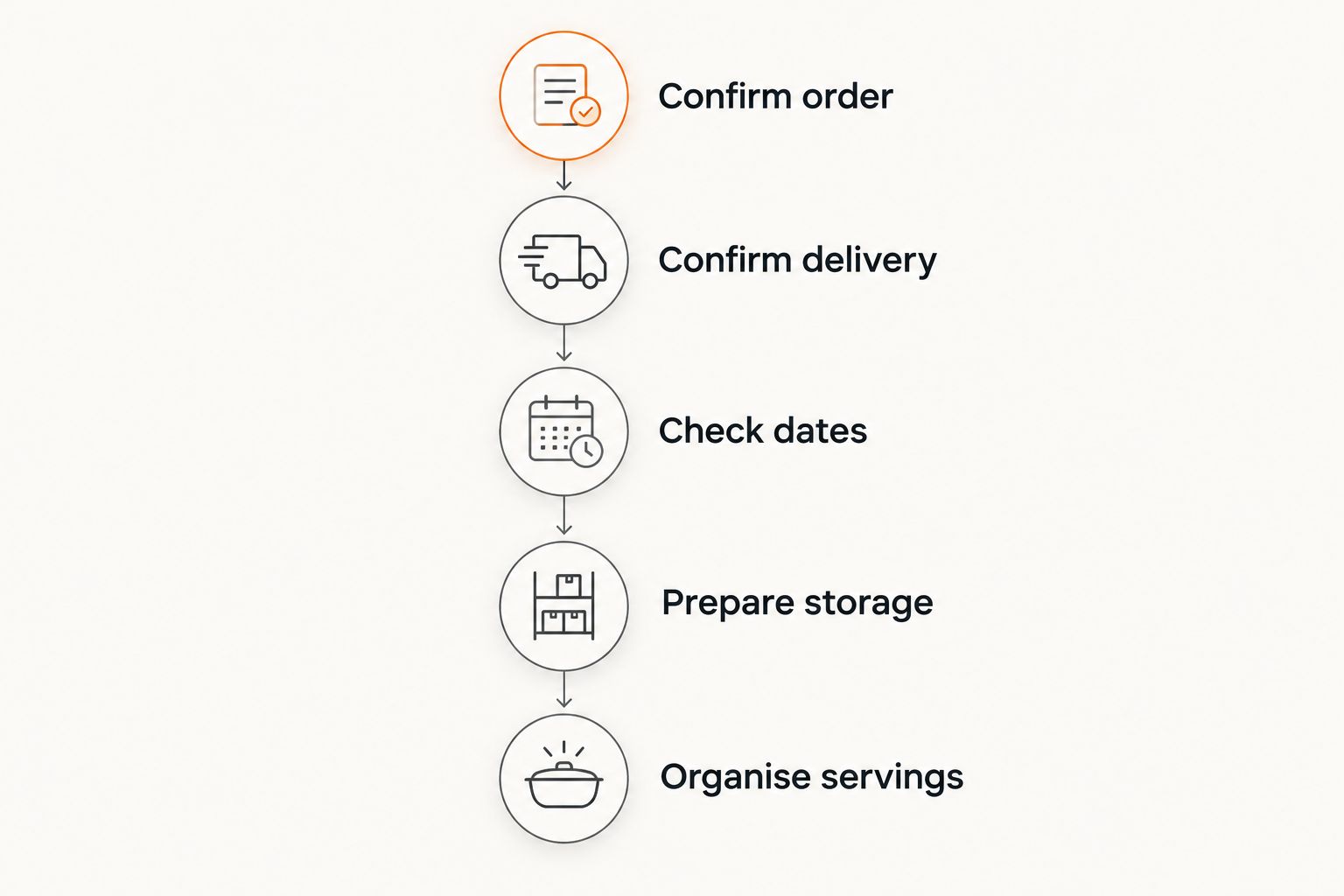
1. Confirm the exact order configuration
Check that you have selected the intended programme length and understand what arrives. Do not rely on a product title alone to tell you the selected duration, delivery arrangement or storage method.
Using the stated format of seven 375 ml servings per cleanse day, your planning quantities are:
| Planning quantity | Amount | What it means for storage |
|---|---|---|
| One serving | 375 ml | Check the container’s actual dimensions |
| One day | 7 servings | Keep each day’s selection easy to identify |
| Seven days | 49 servings | Allow room for the full order if it arrives together |
| Total liquid volume | 18.375 litres | Packaging and air circulation need additional space |
These are planning calculations, not the dimensions of a delivery carton. Confirm the contents of your selected order before arranging shelves or buying storage containers.
2. Confirm delivery before choosing your start date
Check whether your address is serviced, which delivery arrangements apply and whether someone can receive the order. Ask how the juice will arrive: refrigerated, frozen or with another specified handling requirement.
Do not build your schedule around an assumed delivery time. A day when you can receive and store the order is more useful than a preferred start date that leaves it unattended.
3. Establish how the final servings will be stored
Ask whether the supplied use-by dates cover your intended final day under the required storage conditions. If they do not, ask whether supplier-approved freezing or a different delivery arrangement is possible.
A programme’s duration is not its shelf life. Resolve that distinction before ordering, rather than trying to stretch a date once the juice is in your fridge.
4. Prepare the cold-storage space
Clear enough room to keep the juice organised without crowding the fridge’s air vents. Use a fridge thermometer rather than relying only on the appliance’s numbered dial.
Food Standards Australia New Zealand’s food-safety guidance sets 5°C or colder as the cold-holding benchmark for potentially hazardous food. For your 2026 storage checklist, use that benchmark and follow any stricter temperature stated on the juice label.
5. Check the order when it arrives
Read the storage instructions and dates before putting everything away. Check containers for leaks, broken seals or damage, and contact the supplier promptly if the delivery condition conflicts with its instructions.
Put the juice into its required storage promptly. Keep the order details and photograph any damaged containers so you can explain the issue clearly.
6. Organise by date, then by day
Place the earliest use-by dates where you can see them. If you group servings into daily sets, keep every original label visible and make sure the grouping does not hide an earlier date.
A simple plan is enough. Record where each day’s servings are stored and any supplier-approved thawing instructions, rather than relying on memory halfway through the week.
Refrigeration or supplier-approved freezing: which fits your plan?
Refrigeration is the straightforward approach when the labelled dates cover the full drinking schedule. Freezing is only an option when the supplier confirms that the specific juice and its container are suitable, with clear freezing and thawing instructions.
Neither method extends permission to ignore a use-by date. Your 2026 plan needs a confirmed storage route for the final serving, not just the first delivery.
| Storage approach | Best for | Practical advantage | Limitation |
|---|---|---|---|
| Refrigeration | Orders whose labelled dates cover the intended schedule | No thawing step to organise | Requires adequate fridge space and dates that cover the week |
| Supplier-approved freezing | Products explicitly confirmed as suitable for freezing | Allows you to follow an approved frozen-storage plan | Requires freezer space and product-specific thawing instructions |
Refrigeration: keep dates visible
Keep refrigerated juice in a consistently cold part of the fridge, with space for air to circulate. Avoid repeatedly taking out the whole day’s supply when you only need one serving.
Leave the juice in its original containers. Decanting adds handling and separates the drink from its ingredient list, date and storage directions.
Supplier-approved freezing: get instructions first
Ask whether to freeze the juice on arrival, how long it can remain frozen and how to thaw it. Also ask how soon it must be consumed after thawing and whether refreezing is prohibited.
Do not improvise by freezing unopened containers without approval. Container suitability and room for expansion matter, and a general juice-storage tip does not answer those product-specific questions.
Why delivery and storage plans vary
The right arrangement depends on the order and your household routine. Check these factors before settling on a start day:
- Delivery condition: Refrigerated and frozen arrivals require different handling; confirm which applies.
- Labelled dates: The dates on the supplied products determine whether refrigeration covers your schedule.
- Container dimensions: Liquid volume alone does not tell you how much shelf space the order needs.
- Available storage: A shared fridge needs room for other food as well as the juice.
- Time away: Work, travel and appointments affect when you can receive deliveries and access refrigeration.
- Freezing permission: Only product-specific instructions establish whether freezing fits your plan.
Homejuice’s cold-pressed juice cleanses suit buyers seeking a structured, certified-organic juice format. The practical trade-off is the storage commitment: seven daily servings require more organisation than keeping a few drinks on hand.
How much fridge space does a seven-day order need?
49 servings contain 18.375 litres of juice when each of the seven daily servings is 375 ml. That is liquid volume, not a fridge-capacity requirement: containers, shelf spacing and airflow all take additional room.
Before clearing your fridge, ask for the packaging dimensions or measure a matching container if you already have one. Check usable shelf height and depth rather than comparing the juice volume with the fridge’s advertised capacity.
If the order will not fit comfortably, resolve that before purchase. Ask about delivery arrangements or choose a schedule that your available storage can safely support; do not depend on a crowded fridge or an unconfirmed freezing plan.
Can you receive the juice before your planned start date?
Receiving the juice before your start date works only when the labelled dates and storage instructions cover the entire interval. Count through to the final serving, including the days between delivery and the start of your programme.
An early delivery is not automatically more convenient. For example, if you intend to start after a busy weekend, you still need confirmed storage for the waiting period as well as the seven drinking days.
For a 2026 calendar reminder, record the delivery date, intended start date and final use-by date separately. Keeping those dates distinct makes a scheduling conflict easier to spot before it becomes a storage problem.
How do you keep juice cold when you leave home?
Take only the servings you need and keep refrigerated juice cold during transport. An insulated bag with sufficient frozen ice bricks is a practical aid, but its presence alone does not prove that the contents remain at the required temperature.
Use refrigeration at your destination where available. Do not treat a car, desk drawer or shaded room as refrigerated storage, and avoid leaving juice in a parked vehicle while you run errands.
Keep track of time outside refrigeration
Food Standards Australia New Zealand’s 2-hour/4-hour rule applies to potentially hazardous food held between 5°C and 60°C. Under that rule, less than 2 hours allows use or return to refrigeration; between 2 and 4 hours means use immediately; more than 4 hours means discard.
The time is cumulative, including transport and time on a bench. Treat this as general food-safety guidance, not a replacement for stricter product instructions or permission to leave juice unrefrigerated routinely.
Make your workday plan realistic
Check that you can use a workplace fridge and that it has space before taking several servings with you. If you cannot keep the juice at its required temperature, change the arrangement rather than assuming the journey will be short enough.
Keep personal servings clearly identified without covering the original labels. Return unused juice to suitable storage only when its handling history and the product instructions allow it.
FAQ
Can I keep a 7 day juice cleanse in the fridge for the whole week?
Only if the supplied use-by dates and storage instructions cover the whole week. A seven-day programme does not establish a seven-day refrigerated shelf life.
How many servings should I plan storage for?
Plan for 49 servings when your selected programme contains seven servings per day for seven days. At 375 ml each, that is 18.375 litres of liquid before allowing for packaging and airflow.
What temperature should my fridge be for cold-pressed juice?
Keep refrigerated juice at 5°C or colder unless its label requires a colder temperature. Check with a fridge thermometer and follow the product-specific instructions.
Can I freeze the juice for later in the week?
Freeze the juice only if the supplier confirms that the specific product and container are suitable. Get instructions for freezing, thawing and consumption after thawing before making your plan.
Should I start my programme on delivery day?
Choose your start day after confirming delivery arrangements and checking the supplied dates. You need a workable storage plan through to the final serving, whether you start immediately or later.
What should I do if my juice arrives damaged?
Contact the supplier promptly if containers leak, seals are broken or the delivery condition conflicts with the handling instructions. Keep the order details and photographs, and do not consume a product you suspect is unsafe.
Can I take a full day of juice to work?
Take a full day’s servings only when you can maintain the required cold-storage conditions during transport and at work. Confirm fridge access and space before packing your order.
One last thing
The easiest mistake is organising by flavour and overlooking the dates. Put date order ahead of drinking order, then check that each planned day still follows the supplier’s programme and handling instructions.
Before your 2026 order, send Homejuice one practical question: can the supplied dates and storage instructions cover your intended delivery-to-final-serving schedule? That answer gives you a firmer starting point than guessing how long cold-pressed juice should last.