
Best overall for low sugar kombucha: choose a bottle whose nutrition panel meets Australia’s low-sugar standard. Best plain-flavour starting point: Original Organic Kombucha - No Infusions; best peppermint option: Apple, Peppermint and Chlorophyll Kombucha; best ginger-led option: Hibiscus, Lemongrass and Ginger Kombucha—these are flavour picks, not a ranking of sugar content.
- Choose low sugar kombucha by grams of sugar per 100 mL, not flavour names or organic claims.
- Australia’s low-sugar limit for liquids is 2.5 g of sugars per 100 mL.
- Homejuice stocks Original Organic Kombucha - No Infusions, a plain-flavour starting point; check its sugar panel before choosing.
- Compare bottle size and sweeteners after checking sugar concentration.
Why this matters
Choosing kombucha should feel straightforward. Yet an organic label, a sharp taste and a fruit illustration answer different questions from the one you came here to ask: how much sugar does this drink contain?
For your 2026 shortlist, put the nutrition panel ahead of the product name. Fermentation uses sugar, but the word “fermented” does not tell you the finished drink’s sugar content. Neither does “original”, “natural” or “no infusions”.
Homejuice offers several kombucha flavours, so you can choose by both ingredients and taste. Start with the sugar check below, then use the flavour shortlist to find an option you actually want to drink.
What makes the best low sugar kombucha?
Use these criteria in order. A drink should pass your sugar check before its flavour earns a place in your basket.
- Sugar concentration: compare the sugars row per 100 mL, using the same measurement for every bottle.
- Bottle total: check how much sugar you will drink, rather than assuming one bottle equals one labelled serving.
- Sweetener preference: read the ingredient list if you want to include or avoid particular sweeteners.
- Flavour fit: choose plain tea, peppermint or ginger according to your preferences—not an assumed sugar ranking.
- Clear information: favour a decision you can support with the current nutrition panel and ingredient list.
What does “low sugar” mean in Australia?
Under the Australia New Zealand Food Standards Code, Schedule 4, the low-sugar claim condition for liquids is no more than 2.5 g of sugars per 100 mL. Use that standard when assessing low sugar kombucha in 2026.
The same schedule sets the sugar-free claim condition at no more than 0.5 g of sugars per 100 mL. Low sugar and sugar-free are therefore different claims; do not treat them as interchangeable.
These are food-labelling thresholds, not a recommendation about how much kombucha you should drink. Your next step is to check the actual product panel, including its serving information.
Kombucha options at a glance
This table compares flavour and ingredient features stated in the product descriptions. It does not establish that any listed kombucha meets the low-sugar threshold. Use it after checking each option’s current nutrition panel.
| Option | Best for | Standout feature | Key limitation |
|---|---|---|---|
| Original Organic Kombucha - No Infusions | A plain-flavour starting point | Organic tea, spring water, organic sugar and kombucha culture; no extra flavourings | No infusions does not mean no residual sugar |
| Apple, Peppermint and Chlorophyll Kombucha | Peppermint-focused flavour preferences | Sencha green tea with peppermint, apple and chlorophyll | Ingredients alone do not establish its sugar level |
| Hibiscus, Lemongrass and Ginger Kombucha | Ginger-led flavour preferences | A named combination of hibiscus, lemongrass and ginger | Ginger flavour does not prove a drink is low sugar |
The easiest buying rule is consistent across all three: compare sugar first, then choose the ingredient combination you prefer. A flavour you enjoy is useful; a flavour name used as a nutrition shortcut is not.
1. Original Organic Kombucha: best for a plain starting point
Original Organic Kombucha - No Infusions contains organic tea, spring water, organic sugar and kombucha culture. Its description specifies no extra flavourings, making it a straightforward starting point if you want kombucha without a named fruit or herbal infusion.
Homejuice’s Original Organic Kombucha - No Infusions is best for shoppers who want a plain kombucha starting point. That recommendation concerns flavour and ingredient simplicity—not a claim that it contains less sugar than the other options.
Original Organic Kombucha pros:
- The description names the tea, water, sugar and culture.
- No extra flavourings are included in the stated description.
- The plain format gives you a reference point before exploring infused options.
Original Organic Kombucha cons:
- Organic sugar remains an ingredient; organic does not mean sugar-free.
- A plain-flavour format does not establish the finished drink’s sugar concentration.
Best for: beginners who prefer to start without additional named flavourings.
If you are comparing kombucha in 2026, Original Organic Kombucha belongs on a plain-flavour shortlist. Check its current nutrition panel before placing it on a low-sugar shortlist.
Verdict: Hold for the sugar-panel check; choose for the plain format.
2. Apple, Peppermint and Chlorophyll: best for peppermint fans
Apple, Peppermint and Chlorophyll Kombucha combines sencha green tea, peppermint, apple and chlorophyll. The product description identifies The Good Brew Company and states that the drink is brewed and bottled in Australia.
Choose this option because peppermint and apple appeal to you. Neither the green ingredients nor the herbal naming tells you how much sugar remains in the finished drink.
Apple, Peppermint and Chlorophyll Kombucha pros:
- The description identifies the tea base as sencha green tea.
- Peppermint offers a clear ingredient preference to guide your choice.
- The named combination helps you distinguish it from plain and ginger-led options.
Apple, Peppermint and Chlorophyll Kombucha cons:
- Apple in the ingredient description does not quantify the drink’s sugars.
- Peppermint is not a useful proxy for low sugar or sugar-free status.
Best for: shoppers who enjoy peppermint and want an infused alternative to plain kombucha.
Compare this bottle with Original Organic Kombucha using the same per-100-mL column. Do not choose a winner by which name sounds lighter or greener.
Verdict: Hold for the sugar-panel check; choose for peppermint.
3. Hibiscus, Lemongrass and Ginger: best for ginger-led preferences
Hibiscus, Lemongrass and Ginger Kombucha provides a different named ingredient combination from the plain and peppermint options. Its description identifies The Good Brew Company and states that it is brewed and bottled in Australia.
This is a useful shortlist entry if ginger, hibiscus and lemongrass sound appealing. The recommendation stops there: those ingredients do not demonstrate a lower sugar concentration.
Hibiscus, Lemongrass and Ginger Kombucha pros:
- The named ingredients give you a clear flavour direction.
- It offers an alternative to the apple-and-peppermint combination.
- The description identifies Australian brewing and bottling.
Hibiscus, Lemongrass and Ginger Kombucha cons:
- Ginger does not establish the drink’s finished sugar content.
- The ingredient combination is not a substitute for serving and nutrition information.
Best for: shoppers drawn to ginger and herbal ingredient combinations.
If you enjoy a sharp-tasting drink, keep taste and sugar assessment separate. Acidity and sweetness are sensory qualities; the nutrition panel supplies the figure you need for a low-sugar comparison.
Verdict: Hold for the sugar-panel check; choose for the ginger-led combination.
Check the label, then choose your flavour
The Homejuice kombucha options below match the flavour shortlist. Before choosing, confirm each product’s current sugar panel; these cards are not low-sugar certifications.


How to compare kombucha labels without overthinking it
You do not need to judge every detail at once. Follow this sequence, using the bottle or its current product information rather than an old image or remembered claim.
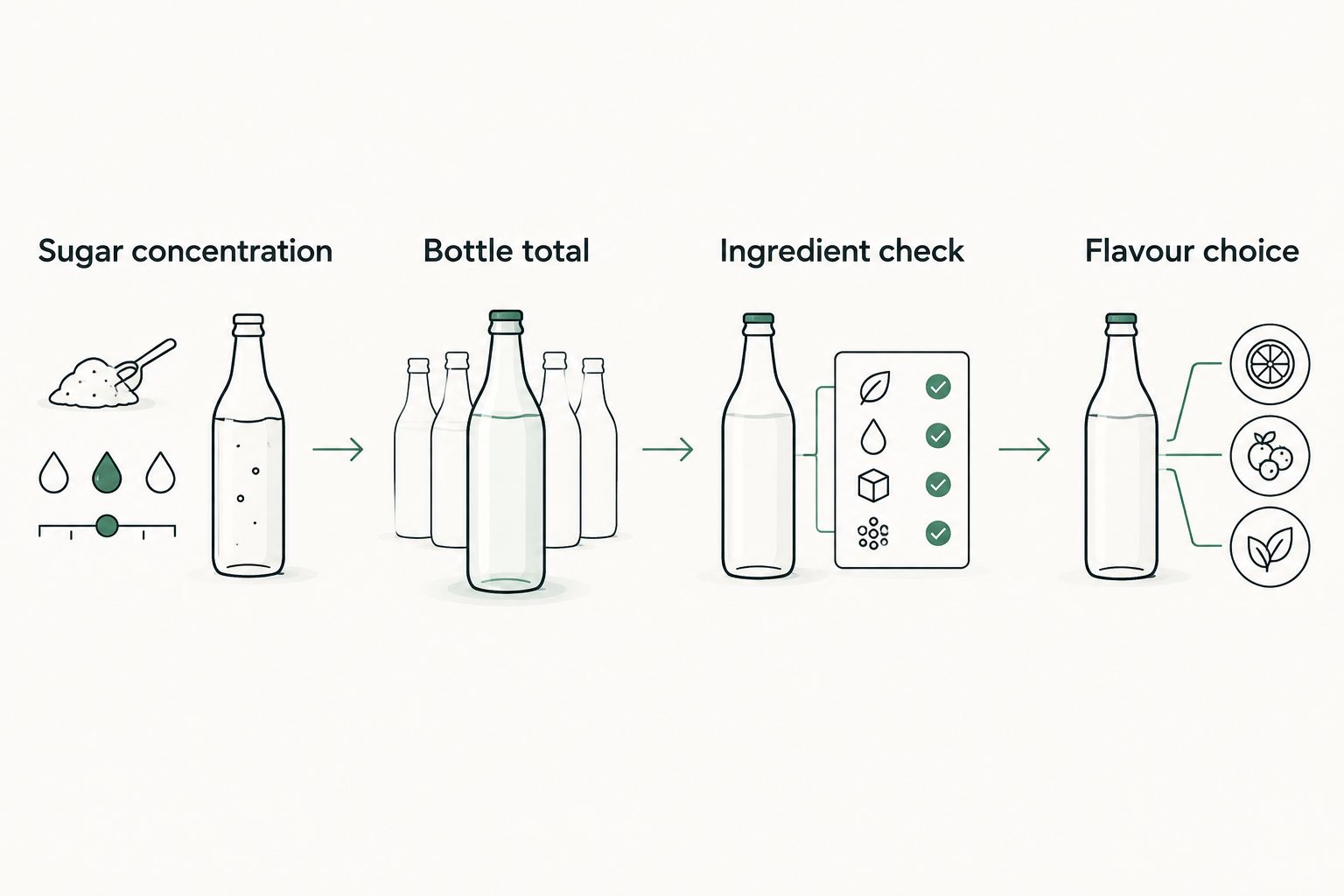
Sugar concentration
Find “sugars” in the nutrition information panel and read the per-100-mL column. This is the like-for-like comparison: bottle sizes and serving sizes otherwise make comparisons harder.
For a low-sugar choice, check the figure against the Australian threshold of 2.5 g per 100 mL. Repeat the same check for every flavour, even when the bottles come from the same range.
Bottle total
Next, look at the amount you intend to drink. The per-serving figure only represents the labelled serving, which is not automatically the whole bottle.
To calculate bottle sugar, multiply the sugars per 100 mL by the bottle volume in millilitres, then divide by 100. Use the actual volume printed on that kombucha bottle; do not borrow serving sizes from juice products.
Ingredient check
Read the ingredients after checking the sugar figure. Look for the tea base, sugar, flavour ingredients and any sweeteners, then decide whether that combination suits your preferences.
Sugar can appear in a kombucha ingredient list because fermentation begins with a sugar-containing mixture. The ingredient list explains what went into the drink; the nutrition panel gives its declared sugar content.
Flavour choice
Finally, choose between the qualifying options on taste preference. A plain tea format, peppermint combination and ginger-led combination serve different preferences without needing different nutrition assumptions.
Keep your 2026 comparison simple: save the product name alongside its sugar concentration and bottle total. Those details are more useful than a list of words such as organic, green or original.
How the shortlist is ordered
The flavour order starts with the simplest stated format: Original Organic Kombucha without extra flavourings. Peppermint and ginger-led options follow as distinct ingredient preferences, not second- and third-place sugar performers.
No option earns a lowest-sugar verdict from its name or ingredient description. A sugar ranking requires comparable nutrition figures for the finished drinks. The criteria above keep that distinction clear while still helping you choose a flavour.
For a 2026 purchase, use the current label to make the final comparison. Treat this shortlist as a practical route through the range, not evidence that a particular recipe has reduced its sugar.
Which low sugar kombucha should you choose?
Choose the kombucha that meets the low-sugar threshold, suits your ingredient preferences and comes in an amount you intend to drink. If several qualify, use flavour as the deciding factor.
For an undecided beginner, start your flavour comparison with Original Organic Kombucha - No Infusions. Prefer peppermint? Compare Apple, Peppermint and Chlorophyll Kombucha next. Prefer ginger? Check Hibiscus, Lemongrass and Ginger Kombucha.
There is no need to force a decision from a product name. Confirm the label first, then choose confidently from the options that meet your criteria.
FAQ
What is the best low sugar kombucha in Australia?
The best low sugar kombucha is one whose current nutrition panel meets Australia’s low-sugar threshold and whose ingredients suit your preferences. Compare sugars per 100 mL before choosing by flavour; the shortlist here does not establish a lowest-sugar winner.
How much sugar can low sugar kombucha contain?
For liquids, Australia’s low-sugar claim condition is no more than 2.5 g of sugars per 100 mL under the Australia New Zealand Food Standards Code, Schedule 4. Check the sugars row in the nutrition information panel.
Is low sugar kombucha the same as sugar-free kombucha?
No, low sugar and sugar-free have different claim conditions. For liquids, the low-sugar limit is 2.5 g per 100 mL, while the sugar-free limit is 0.5 g per 100 mL.
Is original kombucha lower in sugar than flavoured kombucha?
The word original does not establish a lower sugar content. Compare the current nutrition panels for the specific original and flavoured drinks using sugars per 100 mL.
Why does kombucha contain sugar in its ingredients?
Sugar is an ingredient used in kombucha fermentation. Its presence in the ingredient list does not tell you the finished amount; use the nutrition panel to compare declared sugars.
Which Homejuice kombucha should a beginner consider?
Original Organic Kombucha - No Infusions is a straightforward flavour starting point for a beginner who wants no extra flavourings. It contains organic tea, spring water, organic sugar and kombucha culture; check the sugar panel before selecting it as a low-sugar option.
Does organic kombucha automatically mean low sugar?
No, organic and low sugar describe different characteristics. Organic ingredients do not establish the finished drink’s sugar concentration, so check the nutrition panel separately.
One last thing
No extra flavourings does not mean no sugar. Original Organic Kombucha explicitly lists organic sugar among its ingredients, which makes it a useful reminder to separate ingredient simplicity from sugar concentration.
For your next 2026 kombucha purchase, read the sugars row before the flavour description. That small change gives you a clear reason for your choice—without asking a product name to tell you something it cannot.