
Kombucha made with tea contains caffeine, but the amount depends on the recipe and serving size: there is no single caffeine figure that applies to every bottle. Fermentation does not guarantee a caffeine-free drink, so use the finished product’s caffeine information rather than its flavour name to decide whether it fits your routine.
- How much caffeine in kombucha depends on its tea base, recipe and serving size.
- Homejuice lists kombucha containing sencha green tea and yerba mate; neither ingredient is naturally caffeine-free.
- Fruit, flowers and herbs in a flavour name do not establish that kombucha is caffeine-free.
- Compare caffeine per bottle, not just per serving, when choosing your drink.
How much caffeine is in kombucha?
The caffeine content of kombucha is product-specific, not a fixed category number. For a bottle you are buying in 2026, look for caffeine information on its current packaging or ask the maker for the amount in the finished drink. A tea ingredient tells you caffeine is relevant; it does not tell you the final milligrams.
Start with the base, then check the serving. This distinction matters when browsing a mixed selection such as the Kombucha Combo Pack of 8: different flavour names are not proof of different caffeine levels.
| Kombucha option | What the description establishes | Best for | Limitation for caffeine-conscious shoppers |
|---|---|---|---|
| Original Organic Kombucha - No Infusions | Contains organic tea, spring water, organic sugar and kombucha culture | Shoppers who prefer no extra flavourings | An uncomplicated ingredient list does not establish caffeine content |
| Orange Blossom, Passion Flower and Turmeric Kombucha | Contains sencha green tea alongside the named flavour ingredients | Shoppers choosing a green-tea-based kombucha | Floral ingredients do not make the tea base caffeine-free |
| Good Mate (Yerba Mate) Organic Kombucha | Combines kombucha and yerba mate | Shoppers specifically seeking a yerba mate blend | Yerba mate contains caffeine; the ingredient name does not quantify the finished drink |
These are ingredient-based distinctions, not a ranking from lowest to highest caffeine. Do not rank bottles by caffeine unless you have comparable measurements for the finished drinks.
Why this matters
Choosing a flavour and choosing a caffeine level are separate decisions. You can enjoy a fruit-forward or floral kombucha while still drinking a tea-based beverage, and a gentle flavour is not evidence of a caffeine-free recipe.
If you are keeping track of caffeine, include kombucha alongside your other drinks. The practical question is not simply whether it contains caffeine, but how much is in the amount you actually pour.
For your 2026 shopping routine, keep the decision simple: check the ingredients, find the finished-drink figure, then match that figure to the bottle size. You do not need to judge a brewing process from the front label.
Tea-based kombucha: check the finished drink
Black tea and green tea naturally contain caffeine. When either is used to brew kombucha, you should not assume the finished drink is caffeine-free simply because it has been fermented.
The benefit of an identifiable tea base is clarity: you know which ingredient to ask about. The limitation is that the ingredient list alone cannot show how much caffeine was extracted during brewing or remains in the bottled drink.
Best for shoppers who enjoy tea-based flavours: choose the recipe you like, then verify its caffeine content separately. If you need to avoid caffeine, the word kombucha is not enough information to make that decision.
Nor is the colour of the drink a reliable guide. Fruit, flowers and other ingredients affect appearance, so judging a pale drink against a darker one cannot replace a caffeine declaration.
Yerba mate kombucha: do not treat it as herbal tea
Yerba mate naturally contains caffeine. A kombucha that includes yerba mate therefore needs the same label check as a tea-based recipe, even if you usually associate botanical drinks with caffeine-free options.
Good Mate (Yerba Mate) Organic Kombucha explicitly combines kombucha and yerba mate. That makes its base relevant to your choice, but it does not establish a caffeine amount or prove it contains more caffeine than another finished kombucha.
Best for shoppers who specifically want a yerba mate blend: choose it for that ingredient, not for an assumed caffeine dose. If the amount matters to you, ask for milligrams per bottle before deciding.
Avoid a shortcut here: an ingredient associated with caffeine does not let you calculate the whole recipe. Concentration, blending and serving size still matter.
Fruit and floral kombucha: flavour is not a caffeine claim
Apple, peppermint, lavender, hibiscus and other flavour ingredients can make a bottle sound like a herbal infusion. However, the name on the front does not necessarily describe everything used in the base brew.
For example, Apple, Peppermint and Chlorophyll Kombucha includes sencha green tea in its description. The apple and peppermint describe part of the recipe; they do not remove the relevance of the tea.
Best for shoppers choosing by flavour: use the flavour name to narrow down what appeals to you, then read the full ingredients. This gives you a clearer choice without asking the name to answer a question it was not designed to answer.
The trade-off is straightforward. Flavour descriptions help you choose an appealing drink, but they cannot establish whether it meets a caffeine-free requirement.
Why kombucha caffeine varies
A useful caffeine comparison starts with the recipe and ends with the serving you drink. These factors explain why one category-wide figure cannot describe every kombucha:
- Tea base: black tea, green tea and other caffeinated ingredients introduce caffeine into the recipe.
- Brewing strength: the amount of tea used relative to water affects the starting brew’s caffeine concentration.
- Brewing conditions: steeping time and water temperature influence caffeine extraction from tea.
- Recipe blending: adding other ingredients changes the composition of the finished beverage; flavour alone does not reveal the proportions.
- Serving size: drinking a larger volume of the same kombucha means consuming more caffeine.
Fermentation is not a dependable shortcut for estimating the final amount. Neither a longer-sounding brewing story nor a description such as living kombucha supplies a measured caffeine figure.
For a meaningful 2026 comparison, ask the same question of every option: how many milligrams of caffeine are in the same volume of the finished drink? Once you have that information, you can compare bottles fairly.
How do you work out caffeine per bottle?
Use the declared concentration and the amount you drink. Keep the units consistent, and check whether a figure describes a serving, the whole bottle or a standard volume.
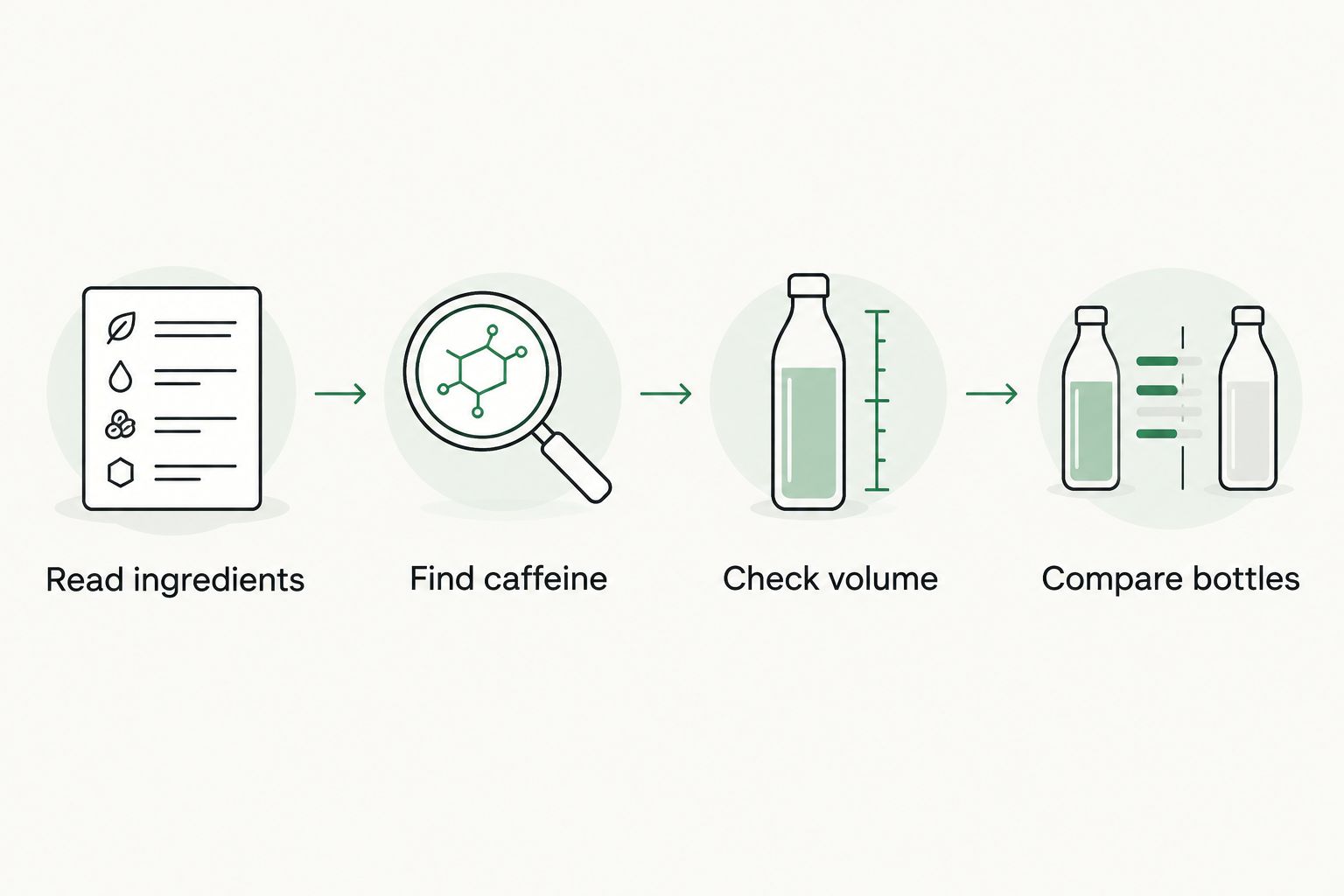
- Read ingredients. Identify tea, yerba mate or another named caffeine source. This step flags what needs checking; it does not produce a caffeine total.
- Find caffeine. Look for a finished-drink declaration in milligrams. If the label does not state it, ask the maker rather than calculating from ingredients.
- Check volume. Note whether the declaration applies per 100 ml, per serving or per bottle. Read the actual container volume too.
- Compare bottles. Convert figures to the same basis before comparing, then account for how much you intend to drink.
The calculation, when a label gives caffeine per 100 ml, is:
Caffeine consumed = declared caffeine per 100 ml × volume consumed in ml ÷ 100.
If a bottle is 375 ml, use 375 ml in the calculation only when that is the volume you drink. A 375 ml serving size elsewhere in a brand’s range does not establish the volume of every kombucha product.
Keep your comparison on the same basis. Milligrams per 100 ml helps you compare concentration, while milligrams per bottle helps you compare your actual choice at the fridge.
What if you want a caffeine-free drink instead?
Choose a drink explicitly identified as caffeine-free rather than treating a low or unknown amount as zero. That is a clearer starting point when avoiding caffeine matters more to you than choosing kombucha.
A separate brewed drink gives you another way to enjoy botanical flavours: caffeine-free loose leaf teas can provide that option without relying on a kombucha flavour name to establish caffeine status. Still read the ingredients of the particular blend, because herbal-sounding names do not rule out added tea or yerba mate.
The advantage is a choice built around your caffeine preference. The compromise is that a herbal infusion is a different drink, not a direct substitute for kombucha’s fermented flavour.
When shopping in 2026, distinguish between a positive caffeine-free statement and silence about caffeine. An absent figure is not the same as a confirmed absence.
Is kombucha caffeine-free after fermentation?
Kombucha is not automatically caffeine-free after fermentation. A fermented tea drink still needs finished-product information before you can describe its caffeine content confidently.
This matters especially when a label emphasises the brewing method. Fermentation describes how the drink is made; it is not a caffeine-free certification.
Does green tea kombucha contain less caffeine than black tea kombucha?
Green tea kombucha is not automatically lower in caffeine than black tea kombucha. The tea quantity, brewing conditions, recipe and serving size prevent a reliable ranking based on tea colour alone.
Compare the finished drinks using the same volume. If one maker provides a per-serving figure and another provides a per-bottle figure, align those measurements first.
Can you judge caffeine by how kombucha tastes?
You cannot reliably judge kombucha’s caffeine content by taste. Sweetness, acidity and flavour ingredients do not provide a measured caffeine concentration.
Choose taste according to your preferences, then handle caffeine as a separate label check. This keeps an enjoyable flavour from becoming an unsupported assumption about the recipe.
Choosing kombucha without overcomplicating it
Homejuice kombucha suits shoppers who want a choice of flavours, not a caffeine dose inferred from a product name. Its listed selection includes original, green-tea-based and yerba mate options, giving you different recipes to consider without needing to turn them into a caffeine ranking.
Homejuice’s Orange Blossom, Passion Flower and Turmeric Kombucha description identifies sencha green tea. Original Organic Kombucha - No Infusions identifies organic tea without extra flavourings. Those details help you choose between recipes, but neither description replaces a finished-drink measurement.
For Homejuice kombucha, the next move is the same as for any other bottle: confirm caffeine information when it affects your choice. Organic ingredients, flavour variety and caffeine content answer different questions.
A simple shopping note for 2026 is enough: preferred flavour, caffeine information and bottle volume. If caffeine is your deciding factor, resolve that question before choosing a mixed pack.
FAQ
How much caffeine is in a bottle of kombucha?
The amount depends on the finished recipe and bottle volume. Use the maker’s caffeine declaration for that product rather than a general kombucha estimate.
Is all kombucha caffeine-free?
No, kombucha made with tea or yerba mate should not be assumed caffeine-free. Look for an explicit caffeine-free statement if avoiding caffeine is your priority.
Does fermentation remove all the caffeine from kombucha?
Fermentation does not guarantee that all caffeine is removed. Check information for the finished drink instead of estimating from the brewing process.
Does fruity kombucha still contain caffeine?
Fruity kombucha can contain caffeine when its base includes tea or another caffeinated ingredient. Read the full ingredients rather than relying on the fruit name.
Does yerba mate kombucha contain caffeine?
Yerba mate naturally contains caffeine, so a yerba mate kombucha needs a finished-drink caffeine check. The ingredient alone does not establish milligrams per bottle.
Can I drink kombucha in the evening if I avoid caffeine?
If you avoid caffeine in the evening, choose a drink confirmed as caffeine-free rather than assuming kombucha meets that requirement. A fruity or floral flavour name is not confirmation.
How do I compare caffeine across different bottle sizes?
Compare caffeine per 100 ml to assess concentration, then compare caffeine in the volume you will drink. A per-serving figure and a per-bottle figure are not interchangeable.
One last thing
The most useful question is not whether a kombucha sounds light, herbal or refreshing; it is how much caffeine is in your actual serving. Keep flavour and caffeine as separate decisions, and you can choose with confidence without overthinking every bottle.