
The best low sugar kombucha for you is the one with the lowest labelled sugar per bottle you actually drink—not simply the least sweet flavour. In Australia in 2026, a liquid must contain no more than 2.5 g of sugars per 100 mL to qualify for a low-sugar claim, but bottle size still determines your total. Use the nutrition information panel to compare both figures before choosing a flavour or mixed pack.
- Food Standards Australia New Zealand sets the low sugar kombucha threshold at 2.5 g of sugars per 100 mL.
- Compare sugar per 100 mL first, then calculate sugar for the whole bottle.
- Homejuice kombucha offers organic options and mixed packs; choose by the individual flavour’s nutrition panel.
- Organic ingredients, tart flavours and no extra flavourings do not establish a lower sugar content.
Which is the best low sugar kombucha in Australia in 2026?
Choose by verified sugar content, then by taste. A flavour name cannot establish which kombucha has the least sugar, and a per-serving figure does not necessarily describe the whole bottle.
Start with the Australian claim thresholds below. These are labelling criteria, not recommended daily intakes or a reason to drink a particular quantity.
| Label claim or comparison | What it tells you | What you still need to check |
|---|---|---|
| Low sugar | A liquid contains no more than 2.5 g of sugars per 100 mL | Bottle volume and total sugar in the amount you drink |
| Sugar free | A liquid contains no more than 0.5 g of sugars per 100 mL | The ingredient list and your flavour preferences |
| Sugar per serving | Sugar in the serving defined on the label | Whether the bottle contains more than one serving |
| Sugar per bottle | Sugar in the entire bottle | Sugar per 100 mL for a fair comparison between different sizes |
Source: Food Standards Australia New Zealand, Standard 1.2.7 and Schedule 4, nutrition-content claim criteria applying to Australian food labelling in 2026.
If you already know how to read the panel, the kombucha flavour guide helps you narrow your taste preferences. Keep the two decisions separate: the panel answers the sugar question; the ingredients help you choose something you will enjoy.
Why this matters
A low-sugar claim describes concentration. It does not tell you how much sugar you will consume unless you also know the amount you pour.
That distinction matters when you compare a small bottle with a larger one, or a single-flavour order with a mixed pack. The lowest figure in the per-serving column is not automatically the lowest-sugar bottle.
You do not need an elaborate scoring system. Use the same measurement for every option, then check the whole-bottle total. This keeps a simple shopping decision from becoming a guessing game about fruit names, sweetness or packaging language.
How do you compare sugar per bottle?
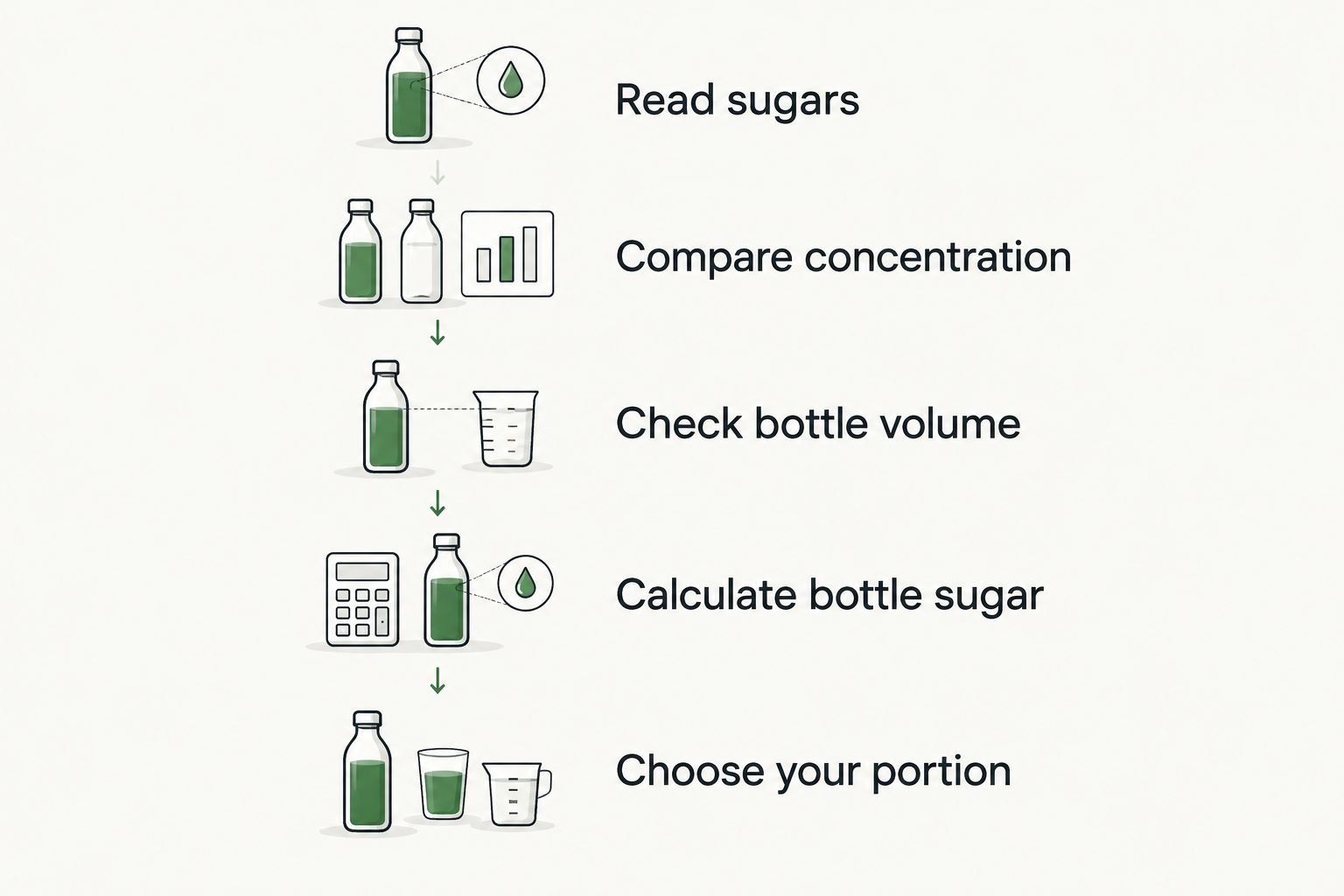
Use this sequence when shopping for low sugar kombucha in 2026. Take the values from the exact flavour and bottle size you intend to buy, rather than another product in the same range.
- Read sugars. Find the sugars row in the nutrition information panel. Do not substitute the total carbohydrate figure.
- Compare concentration. Read sugars per 100 mL across your shortlist. This puts different bottle sizes on the same basis.
- Check bottle volume. Find the full volume printed on the bottle. Do not assume the serving size equals the bottle size.
- Calculate bottle sugar. Multiply sugars per 100 mL by bottle volume in millilitres, then divide by 100.
- Choose your portion. If you drink only part of the bottle, calculate the sugar for that amount instead.
The formula is straightforward:
Sugar per bottle = sugars per 100 mL × bottle volume in mL ÷ 100.
Keep the units together when you write down the result. Your final comparison should show grams per bottle alongside grams per 100 mL, so you can distinguish concentration from quantity.
If the panel also lists servings per package, use that as a cross-check. Sugar per serving multiplied by servings per package should broadly agree with your bottle calculation, allowing for label rounding.
Avoid combining figures from different sources. A serving size from one bottle and a sugar value from another do not produce a meaningful total, even when the flavour names match.
Low sugar: no more than 2.5 g per 100 mL
Best for: shoppers who want a defined Australian label claim without requiring a sugar-free drink. The low-sugar threshold gives you a clear starting point rather than an impression based on taste.
For liquids, the limit is no more than 2.5 g of sugars per 100 mL under the Australian nutrition-content claim rules. A product at the threshold qualifies, but another qualifying product can still contain less sugar.
The advantage is consistency: you can apply the same criterion across your shortlist. The limitation is equally important: the claim does not rank qualifying drinks or account for how much you drink.
Treat the threshold as a filter, not a winner’s badge. Once you have checked it, compare the actual labelled values and the bottle totals.
Sugar free: no more than 0.5 g per 100 mL
Best for: shoppers who specifically want the stricter sugar-content claim. Sugar free and low sugar are different categories; they are not interchangeable descriptions.
The Australian sugar-free threshold for liquids is no more than 0.5 g of sugars per 100 mL. That is a permitted maximum, not a statement that every qualifying drink contains precisely zero sugar.
The benefit is the tighter sugar limit. The trade-off is that the claim tells you nothing about whether you like the taste or ingredients.
Read the ingredient list alongside the nutrition panel, including any sweeteners listed. Choose on the combination that matters to you rather than treating one front-label phrase as a complete product assessment.
Why your sugar comparison varies
Most confusion comes from comparing unlike information. Check these factors before deciding that one bottle is the lower-sugar choice:
- Bottle volume: a larger bottle changes the whole-bottle total even when sugar concentration stays the same.
- Serving size: a small labelled serving can make the sugar figure look lower without changing the drink itself.
- Flavour selection: the supplied range includes original tea-based kombucha and fruit, herb or botanical varieties. Read each flavour’s panel separately.
- Pack composition: a mixed pack brings together individual drinks; it does not give every bottle one shared sugar value.
- Claim wording: organic, original and no extra flavourings describe different product attributes. None replaces a sugar measurement.
In 2026, the practical rule remains simple: check the exact product you are ordering. Do not carry a sugar value across to a different flavour, size or pack without confirming it.
Does original kombucha have less sugar than flavoured kombucha?
Original kombucha is not automatically the lower-sugar option. An original recipe still needs its own nutrition panel, just as a fruit or botanical flavour does.
Original Organic Kombucha - No Infusions lists organic tea, spring water, organic sugar and kombucha culture. That ingredient list describes the recipe, but it does not quantify sugar in the finished drink.
Similarly, the presence of pineapple, apple, ginger or peppermint in a flavour name cannot establish its sugar content. Use those names to choose a taste direction, not to create a sugar ranking.
This distinction makes shopping easier. First select drinks that meet your sugar preference; then decide whether you prefer a plain tea-based flavour or an infused option.
Is a mixed kombucha pack a good starting point?
A mixed pack suits flavour exploration, not a guaranteed lowest-sugar order. It lets you try different options, but a sugar-focused decision still belongs at individual-bottle level.
Homejuice kombucha is best for shoppers seeking organic options and mixed-flavour packs, not a verified lowest-sugar winner.
The two choices below serve different shopping goals. Neither earns a low-sugar recommendation from its name or product description alone.
| Option | Best for | Practical advantage | Limitation for sugar-focused shopping |
|---|---|---|---|
| Original Organic Kombucha - No Infusions | Shoppers who prefer kombucha without extra flavourings | Lists organic tea, spring water, organic sugar and kombucha culture | The ingredient list does not establish grams of sugar per bottle |
| Kombucha Combo Pack of 8 | Shoppers who want to explore different flavours | Offers a mix of kombucha flavours | You need the individual flavour panels rather than one assumed pack-wide figure |
Choose the original option when its stated recipe matches your preference. Choose the mixed pack when discovering flavours matters more than keeping every bottle identical.
Before ordering either, confirm the nutrition information for the exact bottles. That is the deciding evidence when your priority is sugar content.


Does organic mean low sugar?
Organic and low sugar answer different questions. Organic describes a production attribute; low sugar describes the measured sugar content against a defined threshold.
An organic kombucha can list organic sugar as an ingredient. That is not a contradiction, and it is not enough information to calculate the finished bottle’s sugar content.
When comparing Homejuice kombucha, keep organic preference and sugar preference as separate checks. You can care about both without assuming one proves the other.
The same approach applies to other appealing descriptions. A short ingredient list or a drink without extra flavourings can suit your preferences, but neither supplies the missing calculation.
Can you judge sugar by how sweet kombucha tastes?
Taste is useful for enjoyment, not measurement. Kombucha’s acidity and other flavour characteristics influence how sweet it seems, so tartness is not a substitute for the sugars row.
A sharp citrus flavour can taste quite different from a floral or tea-forward drink. That sensory difference does not establish which contains fewer grams of sugar.
Try flavours to find what you enjoy, then return to the nutrition panel for the comparison. Keeping those jobs separate prevents a common mistake: treating a less sweet impression as a verified lower-sugar result.
Your 2026 low-sugar shopping checklist
Before you place an order, make sure you can answer the questions below. Save the label information with your shortlist so you are not comparing one complete panel against another product’s headline description.
- Have you checked the exact flavour rather than a general range description?
- Are you comparing sugars per 100 mL across every option?
- Have you recorded the bottle volume separately from the serving size?
- Have you calculated sugar for the amount you actually plan to drink?
- Does each bottle in a mixed pack meet your preference individually?
- Have you read the ingredients as well as the front-label claim?
If you need clarification, ask for a clear photo of the nutrition information panel and ingredient list. Specify the flavour and bottle size so the response answers your actual shopping question.
You do not need to choose the most complicated flavour or the biggest pack to get started. Begin with a recipe you like and a label you can compare confidently. A clear decision is more useful than a strong claim that does not answer your sugar question.
FAQ
What counts as low sugar kombucha in Australia?
Low sugar kombucha must contain no more than 2.5 g of sugars per 100 mL to qualify for the Australian low-sugar claim for liquids. Check the whole-bottle total as well, because the claim measures concentration rather than your portion.
How do I calculate sugar in a whole bottle of kombucha?
Multiply sugars per 100 mL by the bottle volume in millilitres, then divide by 100. Use the values from the exact flavour and bottle size you are buying.
Is sugar-free kombucha the same as low-sugar kombucha?
No. For liquids, the Australian sugar-free threshold is no more than 0.5 g of sugars per 100 mL, while the low-sugar threshold is no more than 2.5 g per 100 mL.
Does original kombucha always have less sugar?
Original kombucha does not automatically have less sugar than flavoured kombucha. Compare the finished drinks’ nutrition information panels rather than assuming the recipe name establishes a ranking.
Does organic kombucha contain sugar?
Organic kombucha can contain sugar, including organic sugar listed as an ingredient. Organic status does not establish the amount of sugar in the finished drink.
Can I use one sugar figure for a mixed kombucha pack?
Check each flavour separately rather than applying one sugar figure to an entire mixed pack. A mixed selection is useful for exploring taste, but each bottle needs its own comparison.
Is Homejuice kombucha a verified lowest-sugar choice?
A lowest-sugar recommendation requires a like-for-like comparison of current nutrition panels. Choose Homejuice kombucha for its stated organic options and flavour selection, then verify sugar content for the individual bottle.
One last thing
The lowest per-serving number is not necessarily the lowest per-bottle number. Before you settle on a favourite, turn the bottle around and check how many servings it contains.
That small habit keeps your comparison honest. Start with sugar per 100 mL, finish with the amount you drink, and let flavour decide between the options that fit.