
Wellness tonics last only as long after opening as the bottle’s specific storage and consumption instructions allow; there is no single safe timeframe for every tonic. Follow any refrigeration requirement and finish-by instruction together, because the unopened date alone does not tell you how long an opened bottle keeps.
- Wondering how long do wellness tonics last once opened? Follow the bottle’s after-opening instructions, not a generic timeframe.
- For Homejuice wellness tonics, check storage directions before opening and record the opening date.
- An unopened use-by date does not replace a shorter after-opening instruction.
- If refrigeration is required, keep the tonic cold and account for time outside the fridge.
Why this matters
An opened tonic needs a different storage decision from a sealed one. Opening breaks the seal and introduces opportunities for contamination through hands, drinking, pouring and contact with the cap.
If you are choosing wellness drinks from Homejuice, make the storage label part of your buying decision. A bottle that fits comfortably into your routine is a better choice than one you cannot finish according to its instructions.
For your 2026 shopping checklist, put three questions ahead of flavour: where does it need to be stored, what changes after opening, and when must it be finished? The right timeframe belongs to the individual bottle, not the wellness-tonic category.
How long do wellness tonics last once opened?
Use the manufacturer’s stated after-opening period, while also following the bottle’s date mark and storage conditions. If the label gives no after-opening timeframe, ask the seller or manufacturer rather than assigning the tonic a number of days yourself.
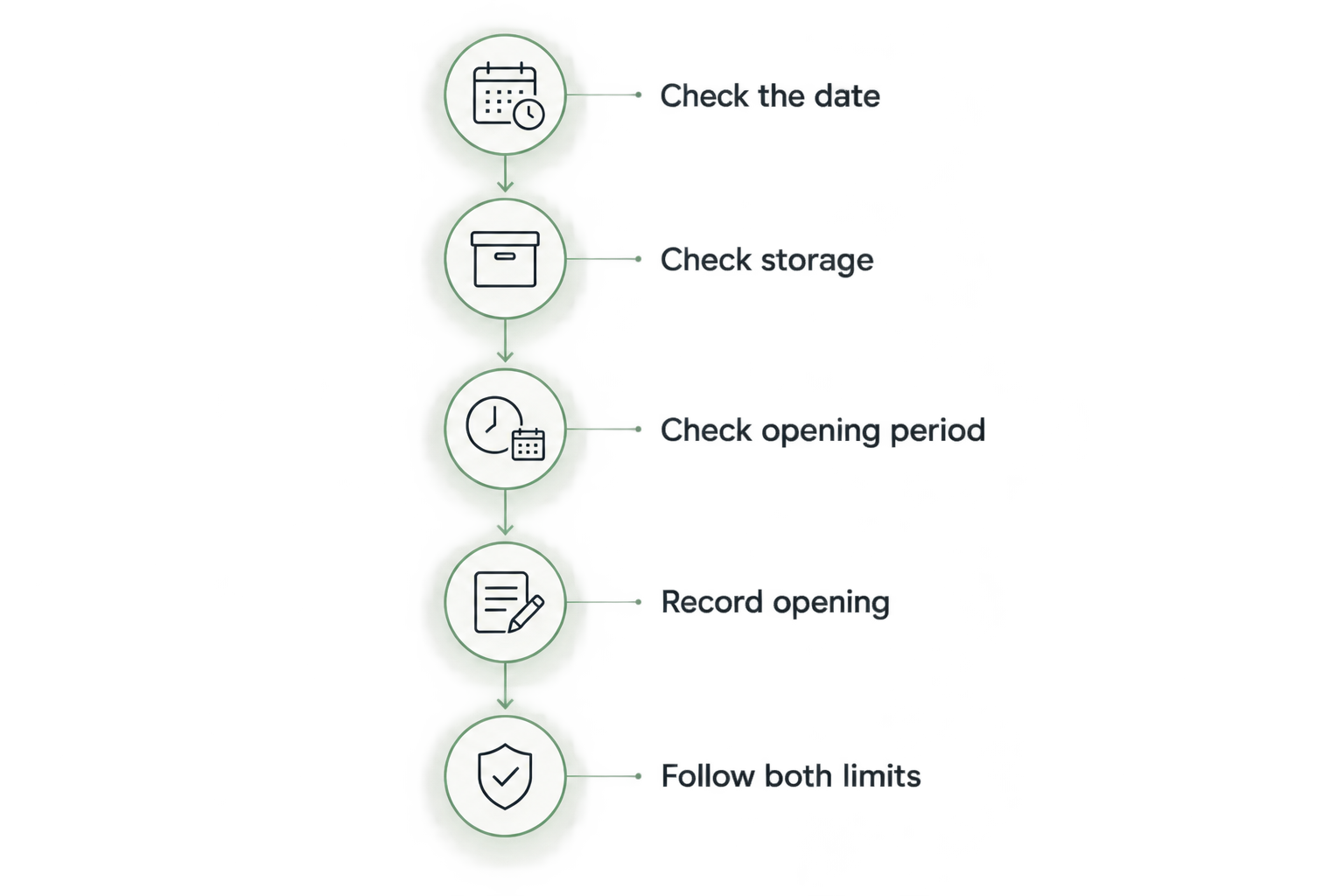
Read the instructions in this order:
- Check the date. Find the use-by or best-before marking and read any conditions attached to it.
- Check storage. Look for directions that apply before opening and any separate instructions for afterwards.
- Check the opening period. Find wording that tells you when to finish the bottle after breaking its seal.
- Record opening. Write the opening date on the bottle or keep a note beside it.
- Follow both limits. Do not treat an after-opening period as permission to ignore an earlier use-by date.
For example, a bottle can still be inside its printed date while already exceeding its stated after-opening period. The reverse also matters: opening a bottle shortly before its use-by date does not extend that date.
Keep these checks with the bottle rather than relying on memory. If someone else in your household opens it first, ask them to record the date straight away so everyone follows the same instructions.
What if the label is unclear?
Do not interpret silence as a long keeping period. Ask specifically whether the product needs refrigeration after opening and how long it should be kept once opened.
For a Homejuice wellness tonic, use the contact page with the product name, batch details and a clear photo of the label. Include when you opened it and how you have stored it; those details make the question more useful than simply asking whether tonics keep well.
Match your storage routine to the bottle
The following comparison is a label-reading guide, not a set of interchangeable storage choices. Choose the row that matches the bottle’s instructions, rather than the storage method that is most convenient.
| Label situation | What to do | Best for | Limitation |
|---|---|---|---|
| Refrigeration required before and after opening | Keep the bottle refrigerated and follow its opening period | A routine with reliable fridge access | A cool-looking room is not a substitute for refrigeration |
| Refrigeration required only after opening | Move the bottle to the fridge immediately after opening | Pantry storage while the bottle remains sealed, where permitted | Sealed-storage permission ends when you open it |
| Storage or opening period unclear | Keep the packaging and request product-specific advice | Resolving uncertainty before drinking | Appearance and smell cannot supply the missing instructions |
A shelf-stable unopened bottle and a refrigerated opened bottle are not contradictory. The packaging and processing can support sealed storage conditions that no longer apply once the seal is broken.
Equally, do not assume every tonic sold in a similar bottle has the same requirements. In 2026, compare the actual directions on the products you are buying, even when their names or ingredients sound familiar.
Why the after-opening period varies
The word tonic does not describe a single recipe or production method. These factors explain why you should not transfer storage advice from one drink to another:
- Ingredients: Different recipes have different storage needs; an ingredient list alone is not a shelf-life calculation.
- Processing: Cold pressing, heat treatment and other production methods are not interchangeable when assessing storage instructions.
- Packaging: The protective conditions inside an intact package change when you break its seal.
- Storage temperature: A product requiring refrigeration must remain within the conditions specified for it.
- Handling: Drinking from the bottle, touching the opening and using an unclean cap introduce contamination opportunities.
- Time since opening: The manufacturer’s after-opening limit still applies when the bottle looks unchanged.
You do not need to work out the chemistry yourself. Your job is to follow the product’s validated directions, not to estimate keeping time from whether a drink contains ginger, herbs, fruit or fermented ingredients.
The same principle applies to product names. A name describing a wellness goal does not establish storage safety, ingredient quantities or a suitable after-opening period.
Refrigerated tonics: temperature matters as well as time
For potentially hazardous food that requires temperature control, Food Standards Australia New Zealand identifies 5°C or colder as the cold-storage temperature. That is an Australian food-safety reference for relevant perishable products, not proof that every wellness tonic belongs in that category.
A fridge thermometer helps you check the actual temperature. Follow any stricter temperature direction on the bottle, and return a refrigerated tonic promptly after pouring rather than leaving it out throughout breakfast.
In this 2026 guide, the distinction is simple: refrigeration helps maintain the required storage conditions, but it does not restart the bottle’s after-opening period. Putting a tonic back in the fridge cannot undo an expired opening limit.
Keep the cap clean and close it securely. Pour into a clean glass if you intend to save the remainder, and avoid touching the neck or the inside of the lid.
What if a refrigerated tonic has been left out?
For potentially hazardous food held between 5°C and 60°C, Food Standards Australia New Zealand’s cumulative 2-hour/4-hour rule provides the following guidance:
- Less than 2 hours: Use immediately or return to refrigeration.
- Between 2 and 4 hours: Use immediately; do not return it to refrigeration for later use.
- More than 4 hours: Discard it.
This rule applies to food requiring temperature control for safety. It is not an after-opening shelf-life claim for all tonics, and it does not override a manufacturer’s more restrictive instructions.
Count the time outside temperature control across separate occasions. A trip home, time on the bench and another serving later belong to the same cumulative total for a product covered by the rule.
Choose a bottle you can finish as directed
Buy for your actual serving routine, not an assumed long keeping period. Before ordering, check the bottle size, labelled serving directions and storage requirements together.
Start with how you plan to use the drink. If you expect to pour occasional servings, confirm that the stated after-opening period suits that pattern before choosing a larger quantity.
The Homejuice range includes bottled wellness tonics, but their names are not a reason to assume identical storage instructions. Check the specific bottle you receive, including any updated label directions, rather than carrying an opening rule across the whole range.
For a practical 2026 buying decision, ask yourself:
- Will I have the required storage space when the order arrives?
- Can I keep the bottle under its required conditions at work or while travelling?
- Will I finish the opened bottle within its labelled period?
- Can I read the storage instructions clearly before discarding outer packaging?
There is no benefit in opening several bottles merely to compare them if you will struggle to finish each one as directed. Keep unopened bottles sealed until you need them, following their unopened-storage instructions in the meantime.
Can I tell whether a wellness tonic has gone off by smelling it?
Smell alone cannot establish that a wellness tonic is safe. Foodborne hazards do not always produce an obvious change in smell, appearance or taste.
Do not taste a questionable drink to test it. Discard a bottle with visible mould, a damaged seal or unexpected leakage, and do not use an apparently normal smell to overrule a use-by date or an exceeded opening limit.
Some products naturally contain sediment or have distinctive aromas. Read any label explanation before assuming a change is normal; familiarity with another drink is not evidence about this bottle.
Does the printed date still apply after opening?
The printed date still matters, but it does not replace the after-opening instructions. Australian use-by and best-before marks have different meanings: a use-by date concerns safety, while a best-before date generally concerns quality under the stated storage conditions.
Do not consume a tonic after its use-by date. A best-before marking is not permission to ignore instructions about refrigeration, damaged packaging or how soon to finish an opened bottle.
If you are checking an older bottle during 2026, read its actual date rather than relying on when you remember buying it. Keep the date mark visible when adding your opening note.
FAQ
How long do wellness tonics last once opened?
Wellness tonics last for the after-opening period stated on their individual labels, provided you follow the required storage conditions. There is no single safe number of days for every tonic.
Do I need to refrigerate a wellness tonic after opening?
Refrigerate a wellness tonic after opening whenever its label requires it. Permission to store a sealed bottle in the pantry does not automatically apply after opening.
Can I drink a tonic that smells fine but is past its use-by date?
Do not drink a tonic after its use-by date, even if it smells normal. Smell cannot reliably establish food safety.
What temperature should I keep a refrigerated tonic at?
For products requiring temperature control for safety, the Australian cold-storage reference is 5°C or colder. Follow the bottle’s specific directions, including any stricter requirement.
Can I put an opened tonic back in the fridge after leaving it out?
That depends on its storage requirements and cumulative time outside temperature control. For potentially hazardous food between 5°C and 60°C, the Australian 2-hour/4-hour rule permits re-refrigeration only when the cumulative time is less than 2 hours.
Where can I check storage instructions for Homejuice wellness tonics?
Check the label on the specific Homejuice wellness tonic you receive. If the after-opening period or storage direction is unclear, request product-specific advice before drinking.
Can I freeze an opened wellness tonic to make it last longer?
Do not assume freezing is suitable for an opened wellness tonic or its container. Ask the manufacturer for freezing and thawing instructions, and do not use freezing to rescue a bottle that has already been stored unsafely.
One last thing
Write the opening date, not just a planned finishing date, on your bottle. Keeping that original detail makes it easier to check the label again, answer a storage question or explain the situation accurately when asking for advice.
A small note removes the guesswork. Leave the ingredients, batch information and printed date readable, then enjoy the drink according to the directions that belong to it.